Motorcades in DC and Force Doctrine
I understand why people are saying “that’s not fair,” and I don’t dismiss that reaction at all. A person is dead, and that matters.
What I’m trying to do isn’t argue what should have happened, but explain how these situations are often interpreted in real time.
Federal agents who are visibly armed aren’t doing so symbolically. It signals that the environment is already considered high risk. In this case, they were outnumbered, blocked in, exposed, and vulnerable.
That shifts the mindset away from something like a routine traffic stop and toward a convoy or column mindset, where unexpected movement or defiance is filtered through a threat lens.
In those moments, responses aren’t calibrated around hindsight, proportionality debates, or future paperwork. They’re driven by immediate control and compliance. Historically, perceived defiance tends to escalate force rather than invite negotiation.
Saying that doesn’t mean the outcome was right or justified. It means this is how enforcement power often functions, and that reality can be tragic while still being real.
I’m sensitive to this because I’ve personally seen how quickly that threat lens snaps into place. Years ago, when I was a bike courier in DC, I accidentally merged into a motorcade.
Within seconds, weapons were trained on me and I was told, very plainly, that if I didn’t disengage immediately, I could be shot. Nothing had happened yet. But the posture alone made the stakes unmistakably clear.
In DC especially, people tend to understand just how mortal it can be to unintentionally interfere with federal agents who believe they’re in the middle of protecting an operation.

I understand why people say “that’s not fair.” A person is dead, and that matters. I’m not arguing what should have happened, but how these moments are read in real time. When visibly armed federal agents feel defied, they prioritize immediate control, not hindsight.

Minneapolis driver shot and killed by ICE officer during immigration-related operation, DHS says www.nbcnews.com/news/us-n…
I feel like The Atlantic’s editors now have anti-Trump story commissions set up as mad libs by this point, 10 years into the Age of Donald.
Trump’s Critics Are Falling Into an Obvious Trap - The Atlantic www.theatlantic.com/internati…
Fascinating.
Why Europe Needs to Go It Alone youtube.com/watch
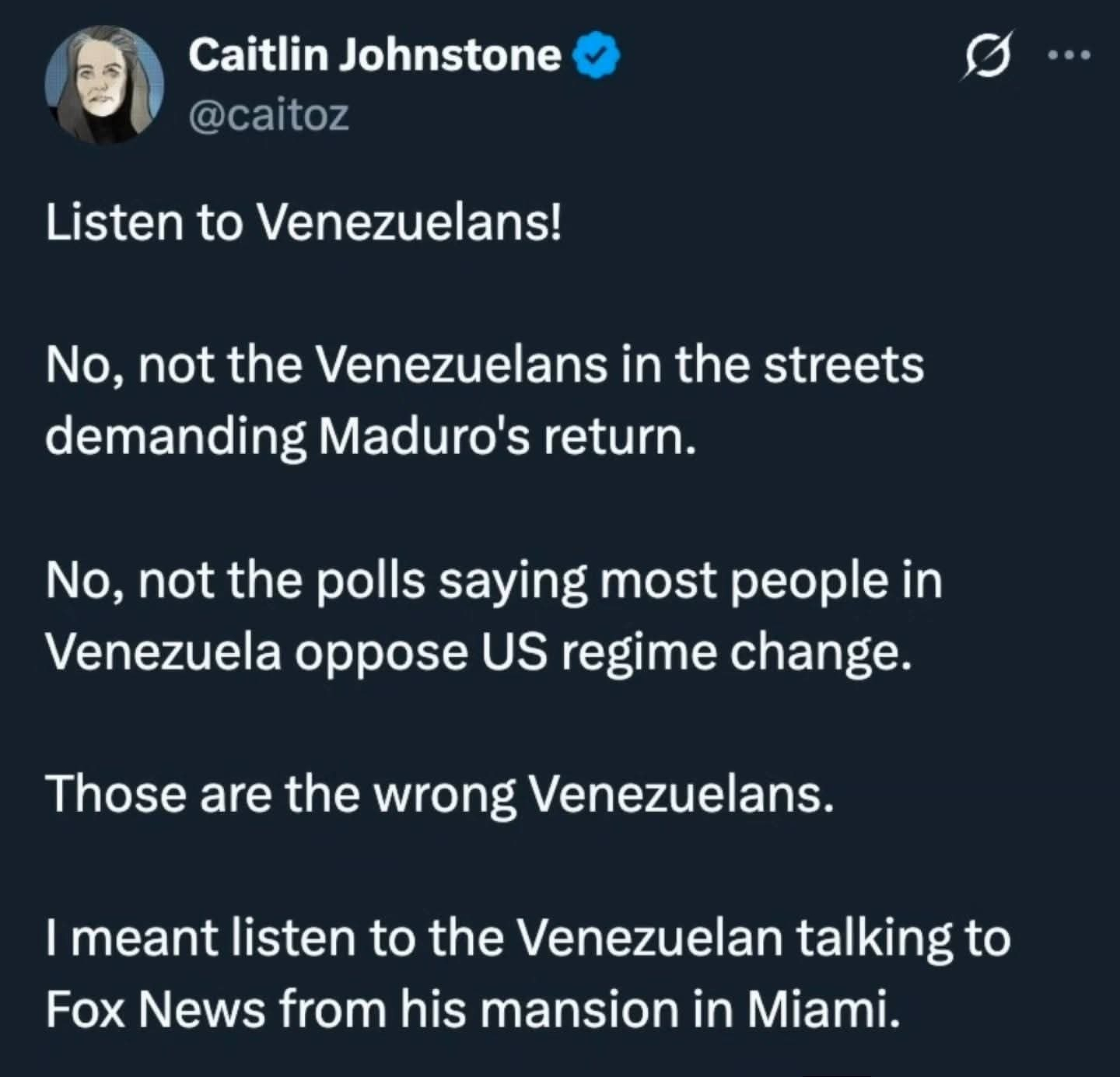
Which Venezuela Propaganda is Truest?
With this much propaganda everywhere, it’s honestly hard to tell which propaganda is closest to reality.
Some of the people we constantly hear from really may be plants, or at least carefully curated voices. Anyone who watches international media long enough knows that a lot of “random” interviewees are selected, coached, or elevated because they say the right things for the narrative being pushed. That’s not paranoia. That’s how modern media works. But the deeper issue is class.
The Venezuelans we’re told to “listen to” are usually elite exiles: English-speaking, media-savvy, often wealthy, often living comfortably abroad. Their resentment is real, but it’s the resentment of people whose ceiling was crushed, not necessarily people who were living near the floor.
When people support systems like socialism or communism, it’s often not because they want luxury or upside. It’s because they want a floor: a floor on how poor they can get, a floor on how vulnerable they are, a floor on how unpredictable life becomes. Removing Maduro may raise the ceiling, but it also risks dropping the floor, and history suggests the first people to benefit from that are usually the already rich.
You see the same dynamic with Cuba. That society holds together because many people long ago accepted ubiquitous education and healthcare over consumer abundance. Literacy and medicine over a capitalist rat race. On a tropical island, a lot of people prefer stability, predictability, and some basic joy in daily life over chasing wealth with no guarantees.
None of this denies suffering. It questions whose suffering gets amplified.
So when someone says “listen to Venezuelans,” the real question isn’t whether Venezuelans are speaking. It’s which Venezuelans, filtered through which incentives, and for whose benefit.


Reminder that J6 was a relative creampuff 🍨 🍦 🥛 🍼 🍭 🍬
At least 35 people have been killed and 1,200 detained in Iran’s economic protests www.newsdoes.com/share/201…
We do indeed live in interesting times.
Minnesota Gov. Tim Walz ends 2026 campaign for reëlection www.axios.com/local/twi…
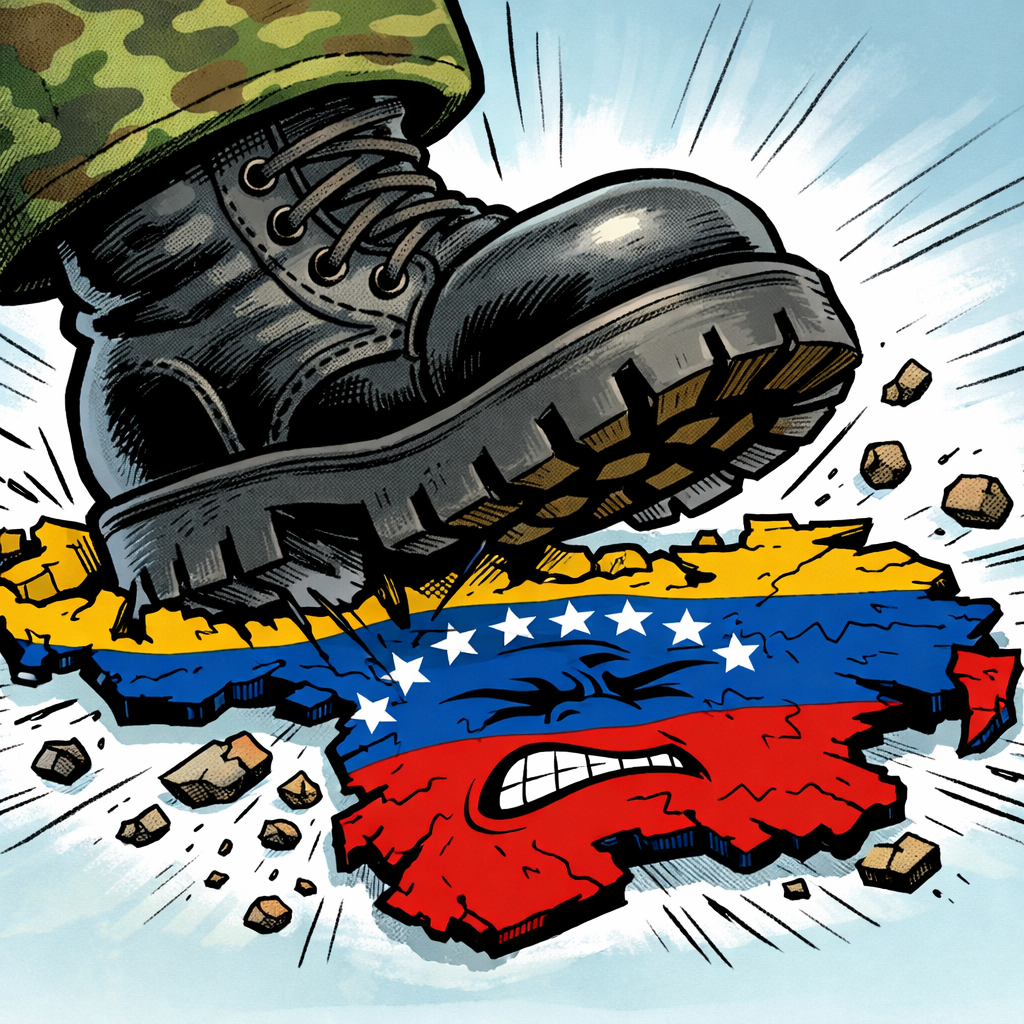
Years of sanctions and embargoes hollowed out Venezuela, then we acted shocked when it destabilized. Now the U.S. literally grabbed Maduro. Economic strangulation, followed by military seizure, isn’t deterrence — it’s manufactured provocation with a predictable endgame.
Pin the Tail on the Mascot
Here’s the symmetry people don’t like to acknowledge.
Many liberals argued that even if Joe Biden were cognitively diminished, senile, or largely absent for stretches of his presidency, it didn’t meaningfully matter. Why? Because the presidency is not a solo act. It’s an institutional machine. A competent, experienced staff can still set policy, execute strategy, manage crises, and move legislation. The White House, they said, still functioned.
That argument is internally consistent. But it doesn’t stop being true when the name on the door changes.
If Donald Trump is a buffoon, a clown, impulsive, or morally unmoored, yet surrounded by a disciplined, ideologically motivated, and strategically effective team, then the same logic applies. Outcomes don’t vanish because you dislike the figurehead. Power doesn’t evaporate because you mock the man at the podium.
In both cases, the real question isn’t the president’s personality or neurological status. It’s the ecosystem: the advisors, the operators, the incentives, the institutional leverage, and the willingness to use it.
Reducing presidencies to “senile grandpa” or “orange clown” isn’t analysis. It’s coping. If you were willing to argue that Biden’s administration functioned despite Biden, you don’t get to pretend Trump’s administration can’t function despite Trump.
Either institutions and teams matter, or they don’t. You don’t get to switch the rule based on who you hate.

I lived in Berlin from 2007 to 2010, and watching this made me curious whether my memories of that period were just personal impressions or reflected real structural conditions at the time. When I was there, energy security was not a constant topic of public concern, and Russian gas was treated as a stable, almost background assumption of European life.
I went back and checked the data. During that period, Germany was already sourcing roughly 35–40% of its natural gas from Russia, with a significant portion transiting through Ukraine. Despite the 2006 and 2009 Russia–Ukraine gas disputes, Germany’s supply was largely maintained, which reinforced confidence in the arrangement. At the same time, Germany was already committed to phasing out nuclear power and expanding natural gas as a bridge fuel.
In retrospect, the calm I remember wasn’t accidental. It was supported by cheap energy, uninterrupted supply, and policy decisions that deferred risk rather than eliminated it. The memories and the facts align more than I expected. youtu.be/zRG_ABrvL…
The more things change the more they stay the same + history doesn’t repeat itself—but it surely and certainly rhymes! youtu.be/b5wfPlgKF…
Fascinating.
Russians are devastated about Venezuela youtube.com/watch
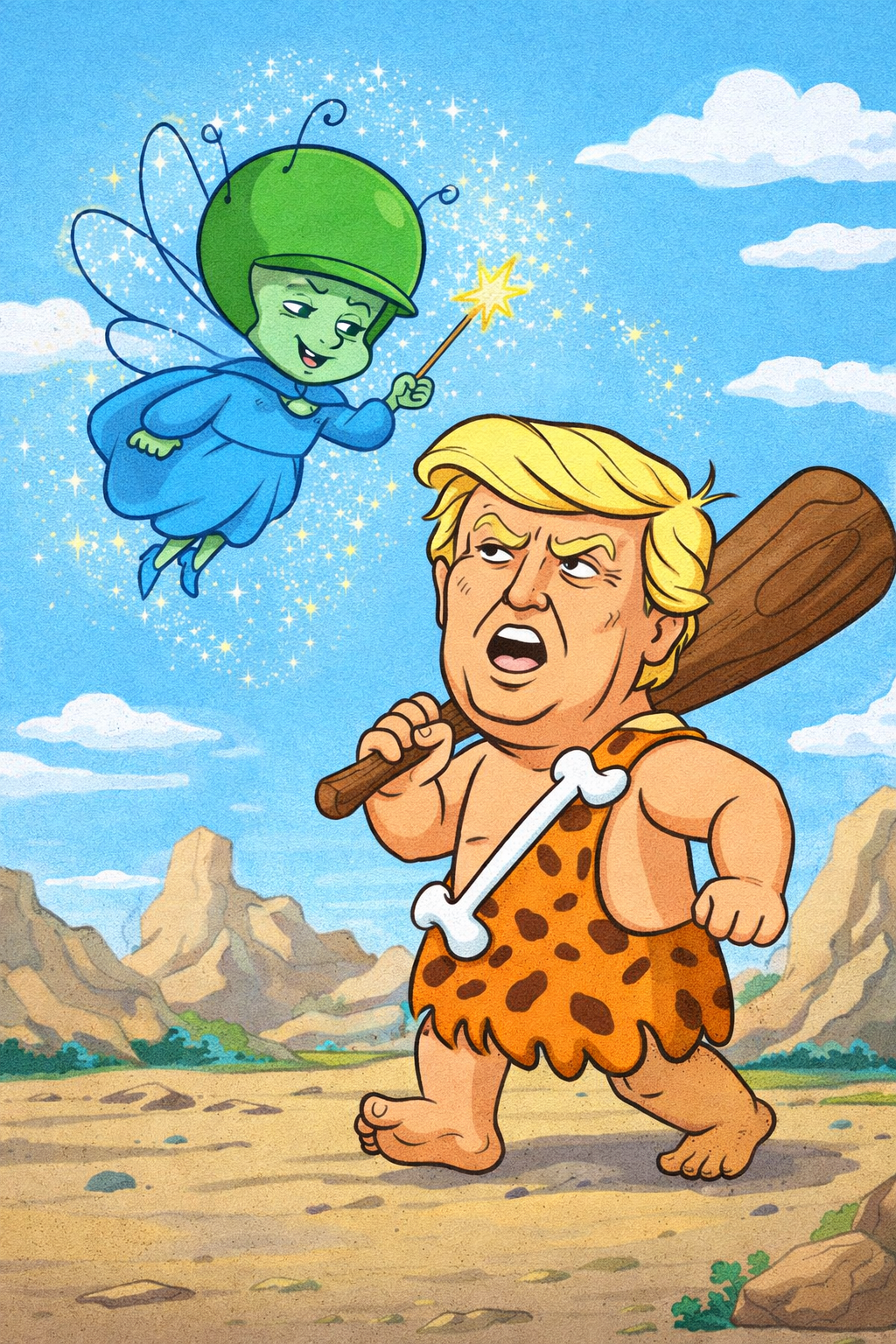
I think it’s very dangerous to dismiss Donald Trump as someone who simply “failed up” into becoming U.S. president—twice. I’ll say it again, because people keep trying to wave this away: it is exceedingly dangerous to treat Donald Trump as a mistake, a fluke, or some kind of cartoonish buffoonery that accidentally captured the presidency of the only superpower in the world. That story may feel comforting, but it does not explain reality.
People like to frame Trump as Bam Bam or “Hulk smash”—noise, impulse, raw force, no cognition. But even if you accepted that metaphor, Bam Bam was a remarkably capable child. He wasn’t random. He was effective. And Trump isn’t Bam Bam anyway.
The only way the “buffoon by accident” theory works is if Trump has a fairy godmother—some blue, unseen hand quietly turning six decades of public life into nothing but luck and coincidence. Otherwise, the record simply doesn’t add up.
No one has a 60-year public career, survives repeated elite attempts at removal, wins the presidency twice, reshapes the Supreme Court, and delivers something as consequential as the rollback of Roe v. Wade by accident or brute stupidity. That’s not how power works.
American presidents have actually gotten better at cartoonifying themselves—at leaning into spectacle, absurdity, or buffoonery—because it creates plausible deniability. It lets people believe that ruthless or carefully calculated outcomes were unplanned, chaotic, or dumb. That misread is the shield.
You don’t have to admire Trump. You don’t have to like him. But dismissing him as slapstick is analytically reckless. His presentation may be crude. His incentives are not. Confusing the two is how people keep getting blindsided. The rest is up to you. You can lead a horse to water, but you can’t make it drink.

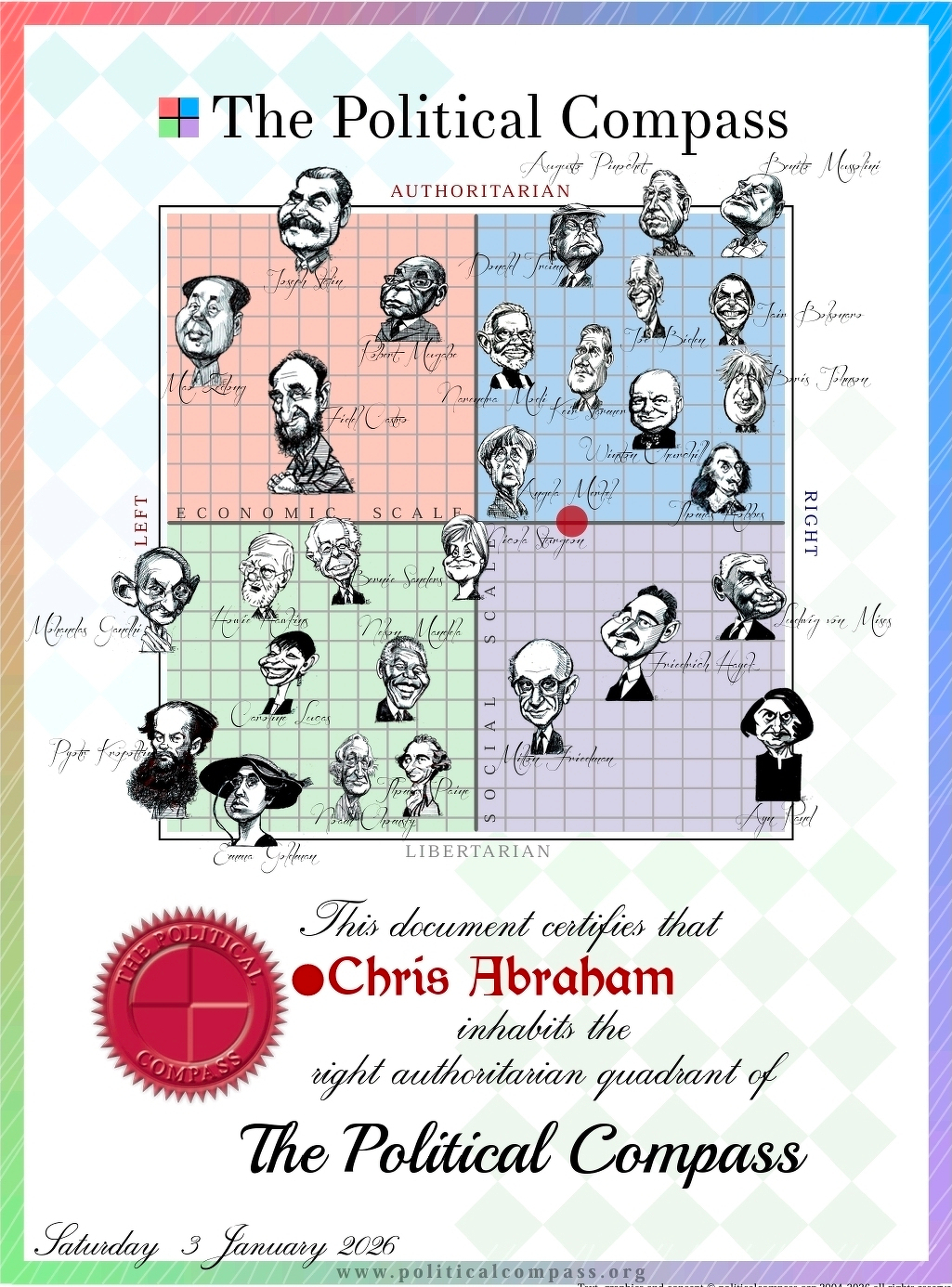
Politically Chris Abraham
I’m economically right, culturally unsentimental, and institutionally serious. I don’t want to rule people or liberate them. I want systems that don’t lie, don’t rot, and don’t pretend incentives don’t exist.
I believe markets are real, scarcity is real, and incentives shape behavior whether we acknowledge them or not. I’m skeptical of redistribution framed as moral virtue rather than practical policy. Good intentions don’t override second-order effects, and pretending they do just pushes costs onto someone else later. Economic policy should work, not perform.
Socially, I’m not interested in moral crusades from either direction. I don’t want the state parenting adults, but I also don’t romanticize disorder or pure libertarian abstractions. Rules matter. Enforcement matters. Order is a prerequisite for liberty, not its opposite. When institutions refuse to enforce boundaries, they don’t become humane, they become arbitrary.
I reject nostalgia politics and culture-war cosplay. I don’t believe tradition is sacred just because it’s old, and I don’t believe novelty is virtuous just because it’s new.
I care about legitimacy that comes from competence, not symbolism. Governance by vibes corrodes trust, and compassion without limits turns into cruelty by diffusion.
I’m skeptical of empire, hostile to ideological universalism, and allergic to systems that lie about tradeoffs. I’m not trying to restore the past or save the world.
I’m trying to keep things from breaking while letting adults live like adults. If I had to name it, I’d call myself an institutional or civic realist: market-leaning, socially non-messianic, and focused on systems that actually function.
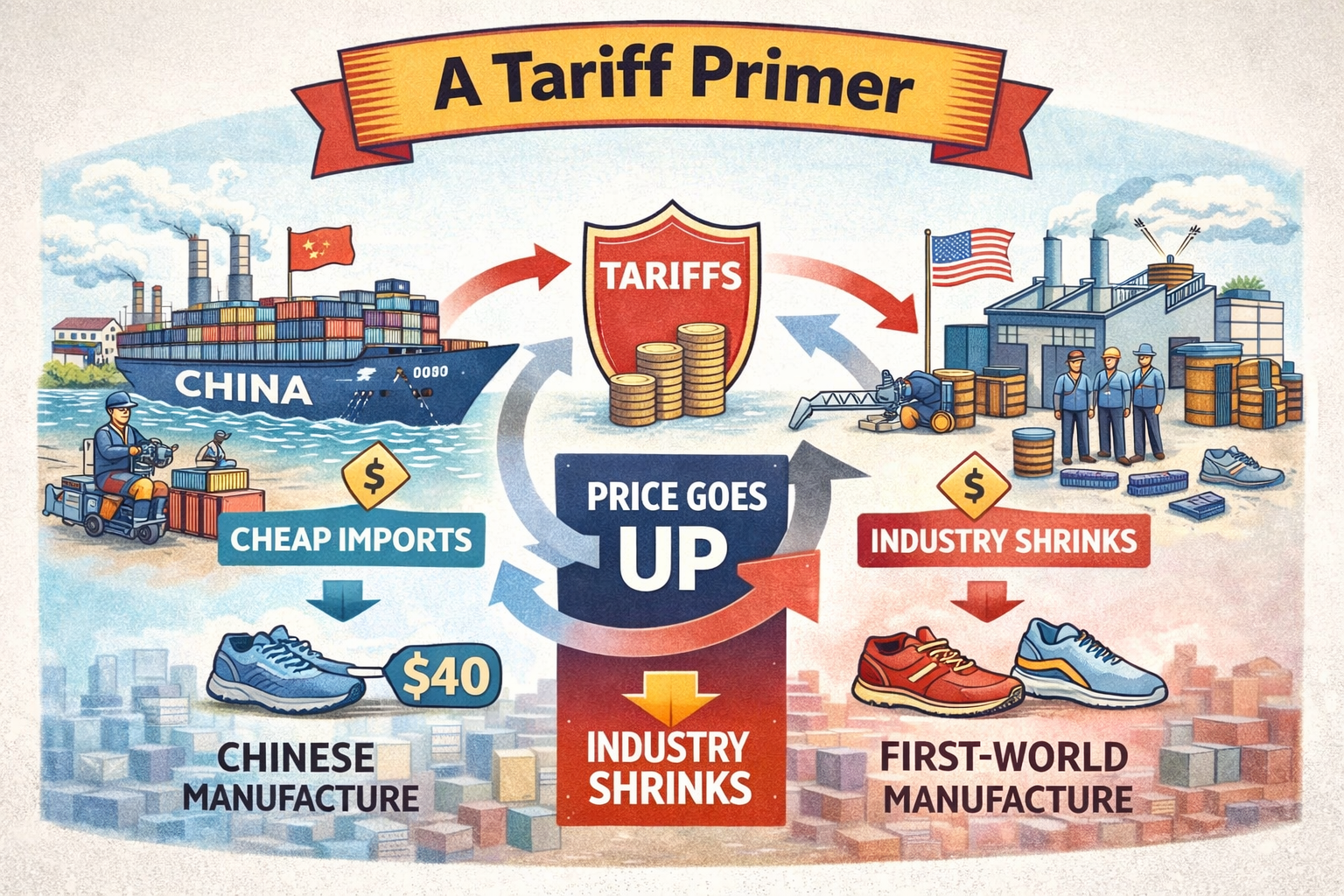
A Tariffs Primer
Tariffs aren’t a moral statement or a magic revenue machine. They’re a blunt economic tool in a trade system that’s never been truly free. Most countries impose higher tariffs and non-tariff barriers on U.S. exports than the U.S. imposes on theirs. When the U.S. raises tariffs, it’s usually not about “making money,” it’s about leverage. You restrict our access, we restrict yours, and eventually someone negotiates.
At the micro level, tariffs do raise prices. That’s Econ 101. If an imported good is hit with a tariff, much of that cost shows up in the domestic price. Consumers and firms bear it. The real question isn’t whether prices rise, it’s why so many prices were so low to begin with.
For decades, Americans have lived at effectively “China prices” while earning first-world wages. Walmart, the dollar menu, and ultra-cheap imports suppressed the cost of daily life even as wages stagnated. That’s why Americans didn’t feel poor for a long time. Real purchasing power was propped up by global labor arbitrage, subsidies, scale, and policy. That’s not a conspiracy. It’s standard macroeconomics.
China doesn’t just compete on efficiency. It subsidizes production, capital, energy, and logistics, tolerates labor and environmental conditions illegal in the U.S., and sells goods at prices domestic producers cannot match. That’s dumping, whether the label is applied or not. Cheap goods feel great, but they hollow out domestic manufacturing.
So tariffs force a tradeoff. Do we want permanently cheap imports and a consumption economy dependent on foreign production, or do we accept higher prices to rebuild domestic industry and jobs for people who aren’t knowledge workers? Without globalized low-cost manufacturing, a pair of running shoes wouldn’t be $40. Prices closer to $150–$250 would be normal, reflecting real labor, compliance, and supply-chain costs.
There’s no free lunch here. Tariffs cost consumers, but dependency costs resilience. The argument isn’t nostalgia or protectionism. It’s whether we want an economy optimized solely for cheap consumption or one that can still make things.