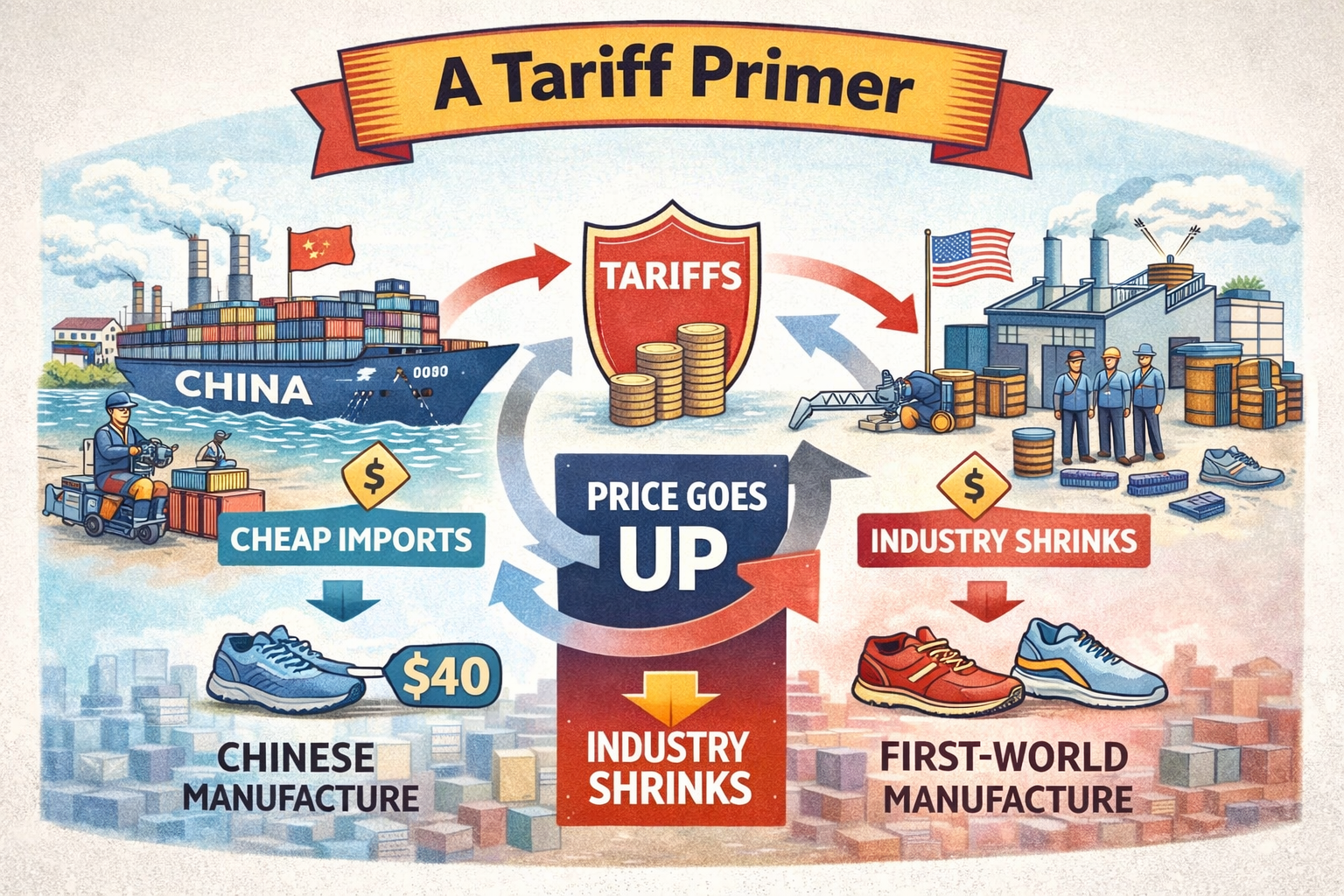
A Tariffs Primer
Tariffs aren’t a moral statement or a magic revenue machine. They’re a blunt economic tool in a trade system that’s never been truly free. Most countries impose higher tariffs and non-tariff barriers on U.S. exports than the U.S. imposes on theirs. When the U.S. raises tariffs, it’s usually not about “making money,” it’s about leverage. You restrict our access, we restrict yours, and eventually someone negotiates.
At the micro level, tariffs do raise prices. That’s Econ 101. If an imported good is hit with a tariff, much of that cost shows up in the domestic price. Consumers and firms bear it. The real question isn’t whether prices rise, it’s why so many prices were so low to begin with.
For decades, Americans have lived at effectively “China prices” while earning first-world wages. Walmart, the dollar menu, and ultra-cheap imports suppressed the cost of daily life even as wages stagnated. That’s why Americans didn’t feel poor for a long time. Real purchasing power was propped up by global labor arbitrage, subsidies, scale, and policy. That’s not a conspiracy. It’s standard macroeconomics.
China doesn’t just compete on efficiency. It subsidizes production, capital, energy, and logistics, tolerates labor and environmental conditions illegal in the U.S., and sells goods at prices domestic producers cannot match. That’s dumping, whether the label is applied or not. Cheap goods feel great, but they hollow out domestic manufacturing.
So tariffs force a tradeoff. Do we want permanently cheap imports and a consumption economy dependent on foreign production, or do we accept higher prices to rebuild domestic industry and jobs for people who aren’t knowledge workers? Without globalized low-cost manufacturing, a pair of running shoes wouldn’t be $40. Prices closer to $150–$250 would be normal, reflecting real labor, compliance, and supply-chain costs.
There’s no free lunch here. Tariffs cost consumers, but dependency costs resilience. The argument isn’t nostalgia or protectionism. It’s whether we want an economy optimized solely for cheap consumption or one that can still make things.