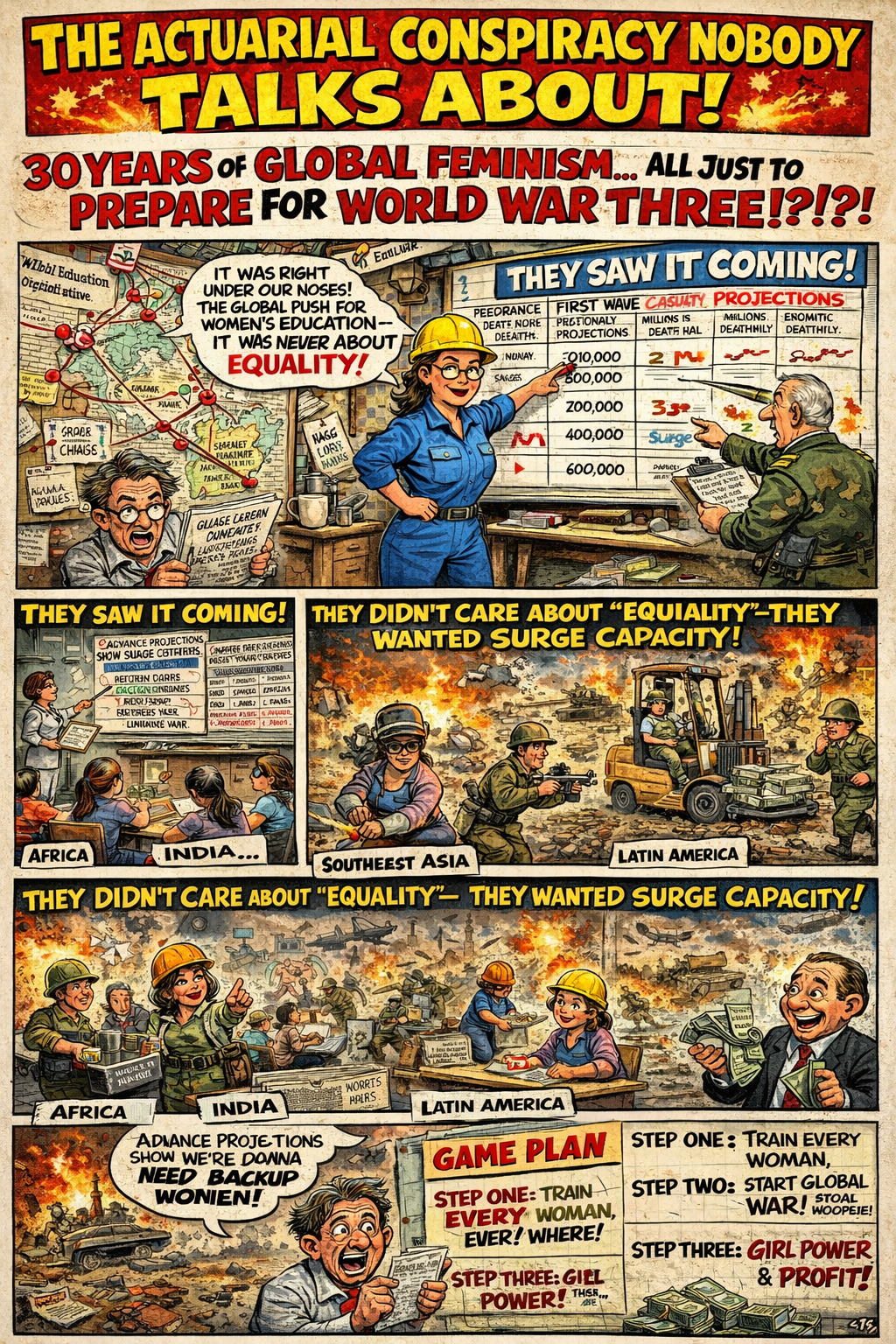
Is global feminism only about wartime economic surge capacity?
Let me be clear upfront: this is fabrication. Fabulism. Fantasy. I made this up. Hold that in mind as you read, because it’s going to feel uncomfortably plausible.
Here’s my favorite conspiracy theory, and I’m furious nobody thought of it first.
Every time a society gets devastated by war—genuinely, catastrophically, demographically devastated—it’s the women who keep the lights on. Not as a surprise. Not as an improvisation. As the only option left standing. Post-WWI. Post-WWII. Every regional conflict that chewed through a generation of young men and spat out widows and rubble. The women went to the factories. The women ran the farms. The women held the economies together with wire and will and no preparation whatsoever. Every single time, humanity got lucky. Every single time, it was chaos first, competence second.
Someone, somewhere, ran the numbers and decided that was unacceptable latency.
Because here’s what the history actually shows: you can survive losing enormous numbers of your men if your women can immediately, competently, step into every economic role required. You cannot survive it if they can’t. The economy doesn’t pause for grief. Supply chains don’t wait for retraining. Cultures that couldn’t make that transition in time didn’t make it at all.
So the theory—my beautiful, ridiculous, unfalsifiable theory—is this:
The global push to educate women in Africa, India, Southeast Asia, Latin America, everywhere that still runs a hard gender division of labor—it isn’t ideological. It isn’t about justice, though justice makes a fine cover story. It’s actuarial. It’s logistical. Somewhere in the long-range planning apparatus of people who think in decades and casualties, someone looked at the projections for resource conflict, climate war, and great-power confrontation and said: we need every woman on earth cross-trained and economically load-bearing before the next one hits.
Not liberation as philosophy. Liberation as surge capacity.
The latency problem is real. You cannot wait until the men are gone to start the training. By then it’s too late—economies seize, supply chains collapse, the recovery curve is brutal and slow and people starve in the gap. But if you’ve spent thirty years quietly, persistently, ideologically-seeming-ly getting women everywhere into skilled work, into management, into trades, into technical roles—then when the catastrophic, unthinkable, absolutely-being-planned-for war arrives, you don’t lose thirty years of economic output. You lose the men. You keep the machine.
It’s been proven. Again and again and again. Nobody prepared for it. Every time, improvisation saved what planning should have guaranteed.
My fantasy is that this time, someone is preparing. That behind every NGO pushing girls' education in rural Bihar, behind every program training women welders in Lagos, behind every quiet policy nudge toward gender parity in skilled trades—there’s a spreadsheet. And on that spreadsheet are casualty projections. And next to those projections is a column labeled economic continuity risk. And someone is trying, for the first time in human history, to get that number down before they need it.
That’s my fabulism. That’s my fantasy conspiracy.
The part that keeps me up at night is how little of it requires fabrication.