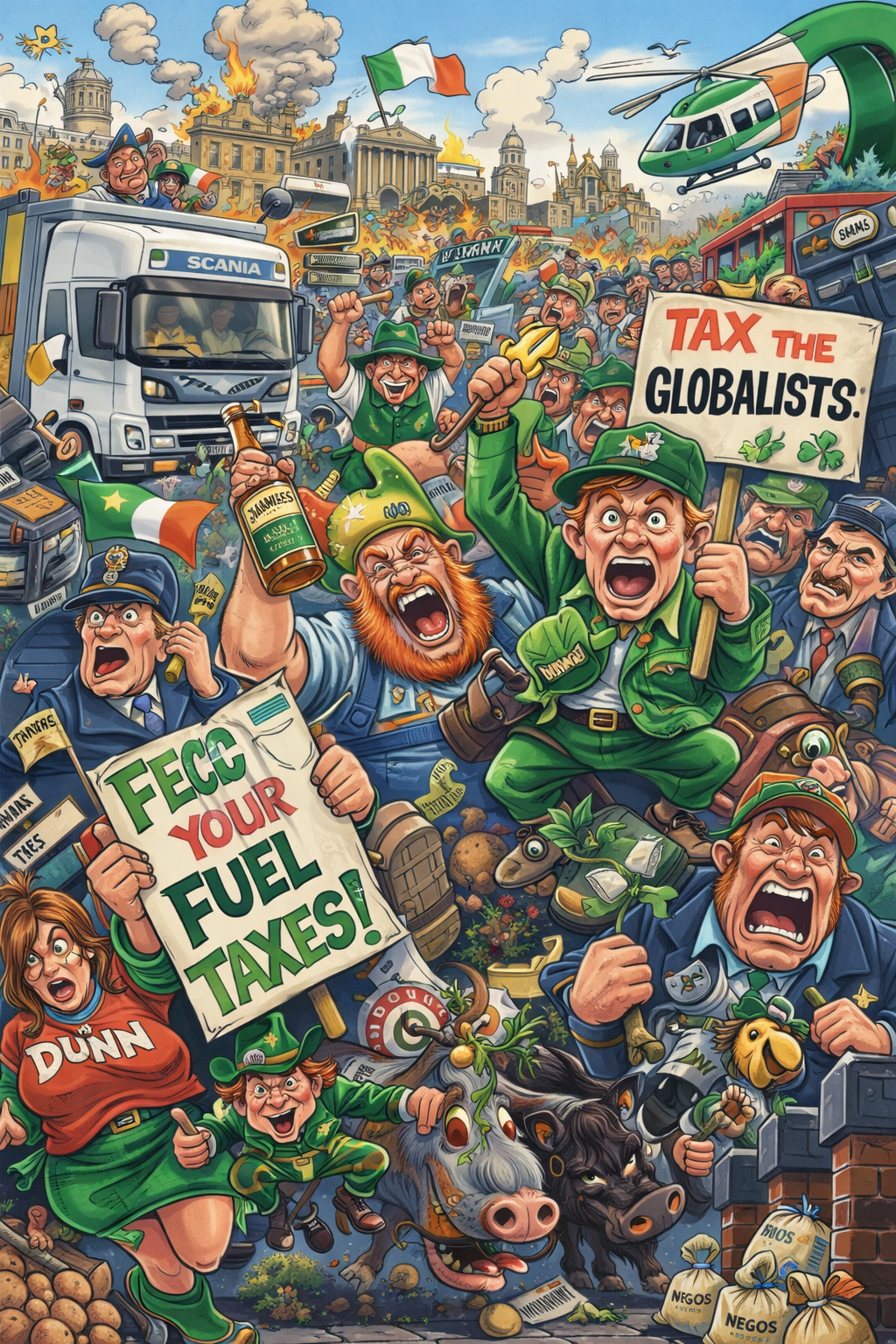
Will Ireland have a civil war before the USA and because of US?
Ireland is a good reminder that the self-appointed vanguard of the proletariat loves the proletariat mostly as an abstraction.
Right now, actual workers in Ireland, truckers, farmers, and other fuel-dependent people, have been out disrupting roads, cities, and supply lines over rising fuel costs. Dublin has been hit, depots have been targeted, and the government has made clear that while protest is technically fine, it has very little interest in treating these people as a legitimate body worth negotiating with. That part matters.
Because this is where the mask usually slips.
The modern managerial left loves “workers” as a poster, a slogan, a moral prop, a bit of museum glass labeled Working Class. What it does not love nearly as much is workers with their own center of gravity. Workers who are loud, blunt, rooted, impossible to curate, and fully willing to tell institutions to get bent. Workers who do not ask to be represented because they are perfectly capable of representing themselves.
That kind of worker is a problem.
So over time, a lot of what calls itself solidarity has quietly shifted away from workers and toward clients, people whose housing, legal status, education, services, identity, and social legitimacy all run through institutions staffed by the same professional class claiming to speak for them. That arrangement is much tidier. Dependency gets renamed compassion. Control gets repackaged as care.
That is why Ireland matters right now. Because when actual working people move under their own power, the people who endlessly invoke “the people” suddenly become anxious, managerial, and faintly contemptuous. The rhetoric stays populist. The instincts turn administrative.
That is also why Eoin Lenihan’s Vandalising Ireland caught my attention. I have not read it yet, but after hearing him interviewed by Bridget Phetasy, the broader pattern was hard to miss. Ireland is not some strange exception. It is one more place where the institutions, government, NGOs, academia, media, all seem much more comfortable speaking for ordinary people than listening to them.
And when those workers push back, they stop being celebrated as the noble working class and start being treated as a disruption to be managed, a nuisance to be smeared, or a threat to be contained.
That is the tell.
The vanguard did not merely lose touch with workers. It replaced them with constituencies that are easier to administer. Ireland is just making that harder to hide.