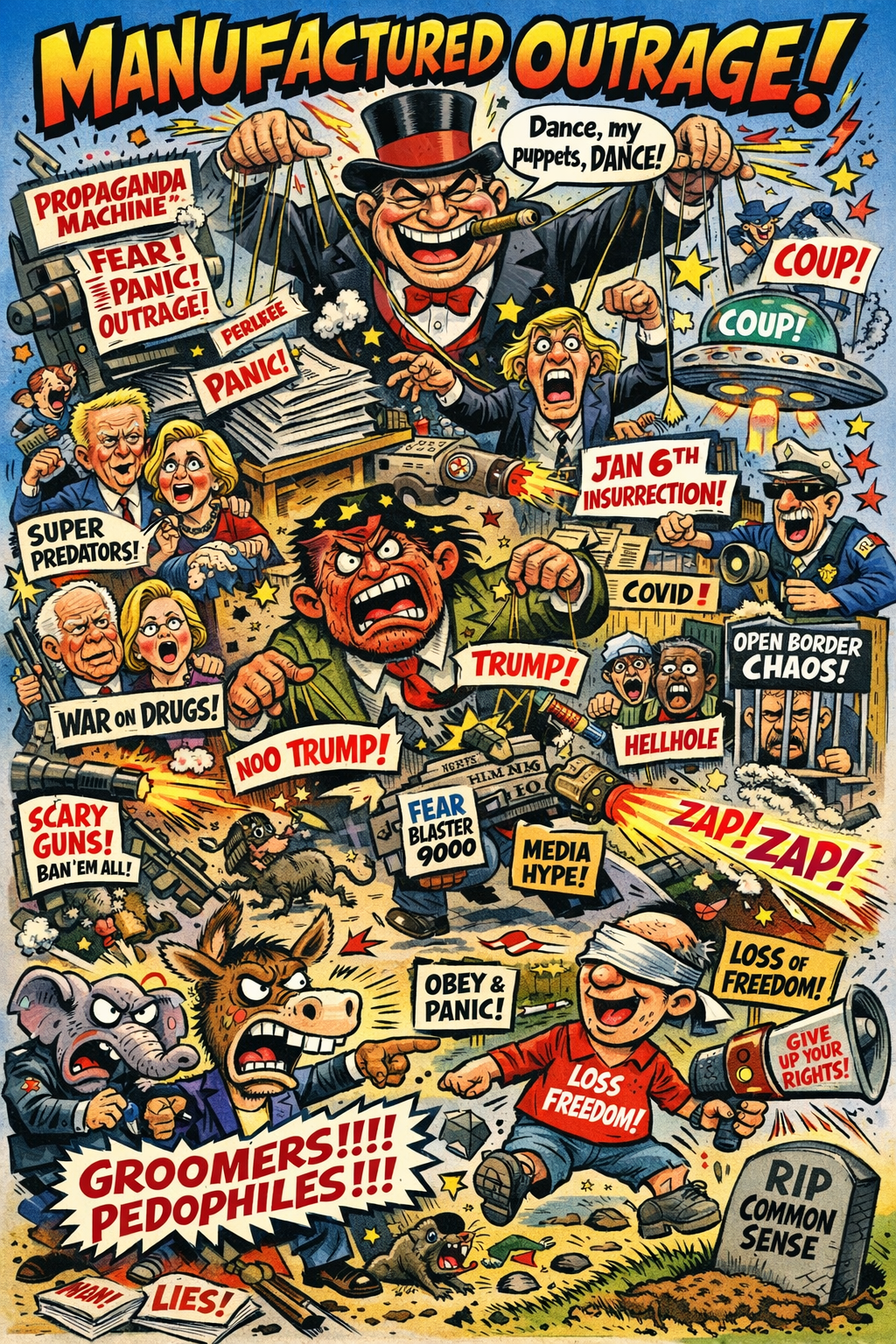
Manufactured outrage is the dark art of turning low-frequency events into high-intensity consensus.
Manufactured outrage is the dark art of turning low-frequency events into high-intensity consensus. You take something real but statistically rare, remove context, widen definitions, and repeat it until it feels ambient—like it could happen anywhere, anytime. Fear does the rest. Once people feel under siege, they’ll accept almost any “solution,” even if it quietly rewrites the rules.
The pattern is consistent. Step one: find a visceral anchor—something involving children, safety, identity, or betrayal. Step two: blur categories so edge cases count as the norm. Step three: saturate attention until perception detaches from probability. Step four: present a preloaded fix that just happens to expand authority or restrict behavior. The outrage isn’t accidental; it’s the delivery system.
This isn’t partisan. The right has done it. The left has done it. Moral panics about crime, drugs, culture, elections—you name it. Each wave reframes the same mechanism: define a threat broadly enough, repeat it loudly enough, and people will trade precision for protection. Once fear is the lens, nuance looks like denial and skepticism looks like disloyalty.
Statistics get bent in the process. Categories get bundled. Context gets buried. A complex mix of causes becomes a single, emotionally satisfying villain. And once that villain is installed, policy debates stop being about trade-offs and start being about urgency. “Do something” replaces “do the right thing.”
The result is a kind of civic autopilot. People think they’re responding to reality, but they’re often responding to a curated version of it—one optimized for reaction. It’s not that the underlying problems are fake; it’s that their scale, framing, and meaning are engineered.
If you want to resist it, you don’t need to pick a team—you need better optics. Ask what’s being counted, what’s being bundled, what’s missing, and who benefits from the emotional spike. Outrage can be justified, but when it arrives prepackaged, synchronized, and oddly convenient, it’s worth checking whether you’re seeing the fire—or the spotlight.