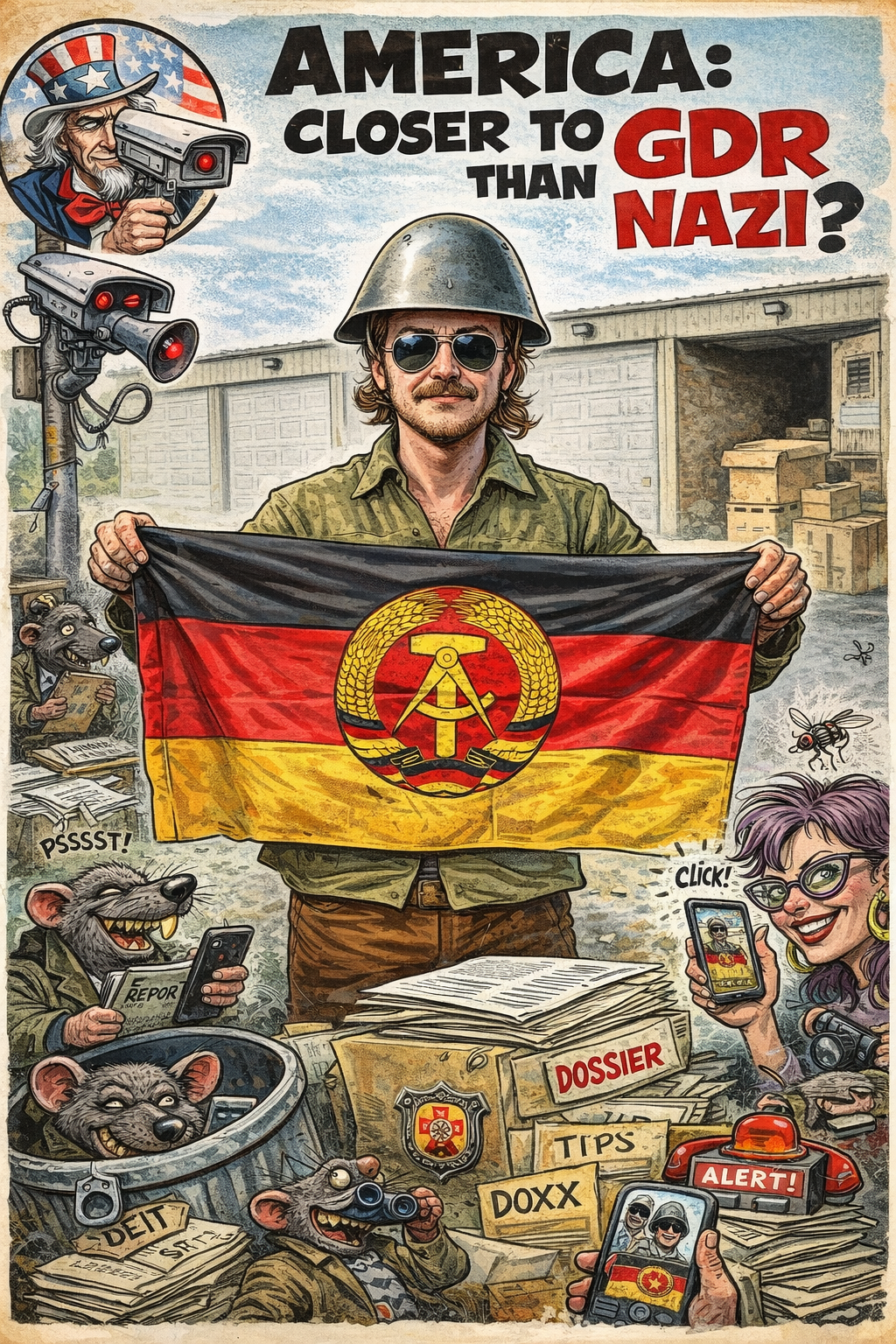
US is Much More GDR/DDR Germany than Nazi Germany
When people reach for “US = Nazis,” I think the better cautionary mirror is the GDR/DDR. Not because we’re recreating East Germany, but because the mechanics are closer: a society that runs on surveillance, files, permission, and social compliance more than torchlit ideology.
Quick primer: the GDR was East Germany (1949–1990), built in the Soviet zone after WWII. It had elections and slogans, but real power lived in the party and the security apparatus. The Stasi (state security) didn’t just “spy”; it built a world where people assumed they were being observed. It recruited ordinary people as informants. It kept dossiers. It used “lived off others” style moralizing about “antisocial” types and parasites to justify pressure, and it made travel, jobs, school, and housing feel conditional. Often the point wasn’t prison. It was making life awkward until you complied.
That’s why I say the US feels more DDR than SS: less mass rallies, more bureaucratic choke points. Today the “file” is your data trail. The “informant” is the tip line, the screenshot, the group chat. “Rat on your neighbor” turns into report buttons, call-outs, and doxxing. The punishment is frequently exclusion: lose the account, lose the job, lose the bank, lose the room in polite society. It’s not one villain; it’s a thousand institutions “just enforcing policy.”
Also: the GDR was uniquely German in its vibe. It inherited a German love of administration, records, and credentialing, then welded that to Soviet-style party control. It wasn’t only a Soviet copy. It was an efficient, paperwork-heavy, domestically staffed system that could feel normal on the surface while quietly coercing underneath.
None of this is sky-is-falling. It’s just a reminder: you don’t need cartoon evil to get real-world control. Sometimes it arrives as “for your safety,” “for trust,” “for the children,” plus a database and a culture that enjoys snitching.