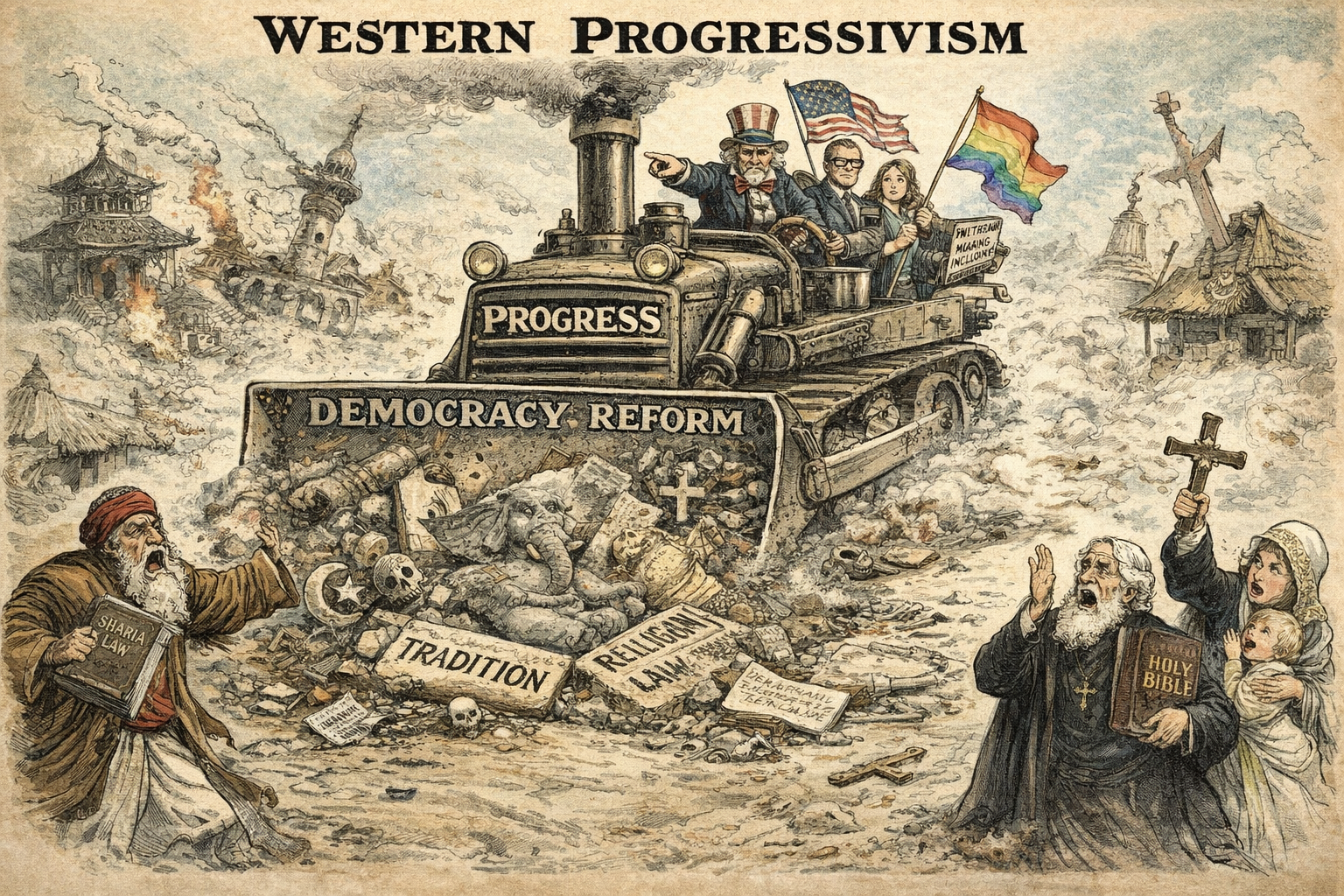
Progress becomes dangerous when it stops being a tool and starts acting like a secular religion
Most of human history did not treat “progress” as the engine of the human condition. Many societies were organized around continuity, sacred order, ancestral duty, hierarchy, and survival, not permanent reinvention. The modern idea that history moves in a single forward direction toward greater freedom, rationality, and liberation is not a universal human instinct. It is a historically specific worldview that became dominant through Western power, institutions, and global reach.
That matters because what the West calls “progress” is often experienced elsewhere as disruption. When democracy, rights language, development policy, or social reform is exported, it often carries a double message: “We honor your dignity” and “your inherited norms must be remade.” Even when the goals are humane, the method can feel like moral intervention backed by money, media, NGOs, diplomacy, and sometimes force. From the receiving end, it can look less like partnership and more like a civilizational rewrite.
This is why progressive politics can function imperially, even when it sees itself as anti-imperial. Older imperial projects spoke in the language of civilization, order, and empire. Newer ones often speak in the language of rights, inclusion, democracy, and public health. Different vocabulary, same temptation: to assume one moral framework is universal and that history itself authorizes intervention.
That does not mean all universal claims are fake, and it does not mean every local tradition deserves protection from criticism. Some traditions are cruel. Some anti-imperial rhetoric is just a shield for local elites preserving power. The point is not “tradition good, progress bad.” The point is legitimacy.
Who decides what changes? By what means? At what pace? With what consent?
Progress becomes imperial when it is imposed from outside, accelerated beyond social legitimacy, tied to humiliation, or enforced selectively. It becomes credible when it is argued locally, translated into local moral language, adopted through consent, and allowed to emerge at a pace a society can absorb.
So my view is not that progress is a lie. It is that progress becomes dangerous when it stops being a tool and starts acting like a secular religion, complete with missionaries, heretics, and a mandate to remake the world.