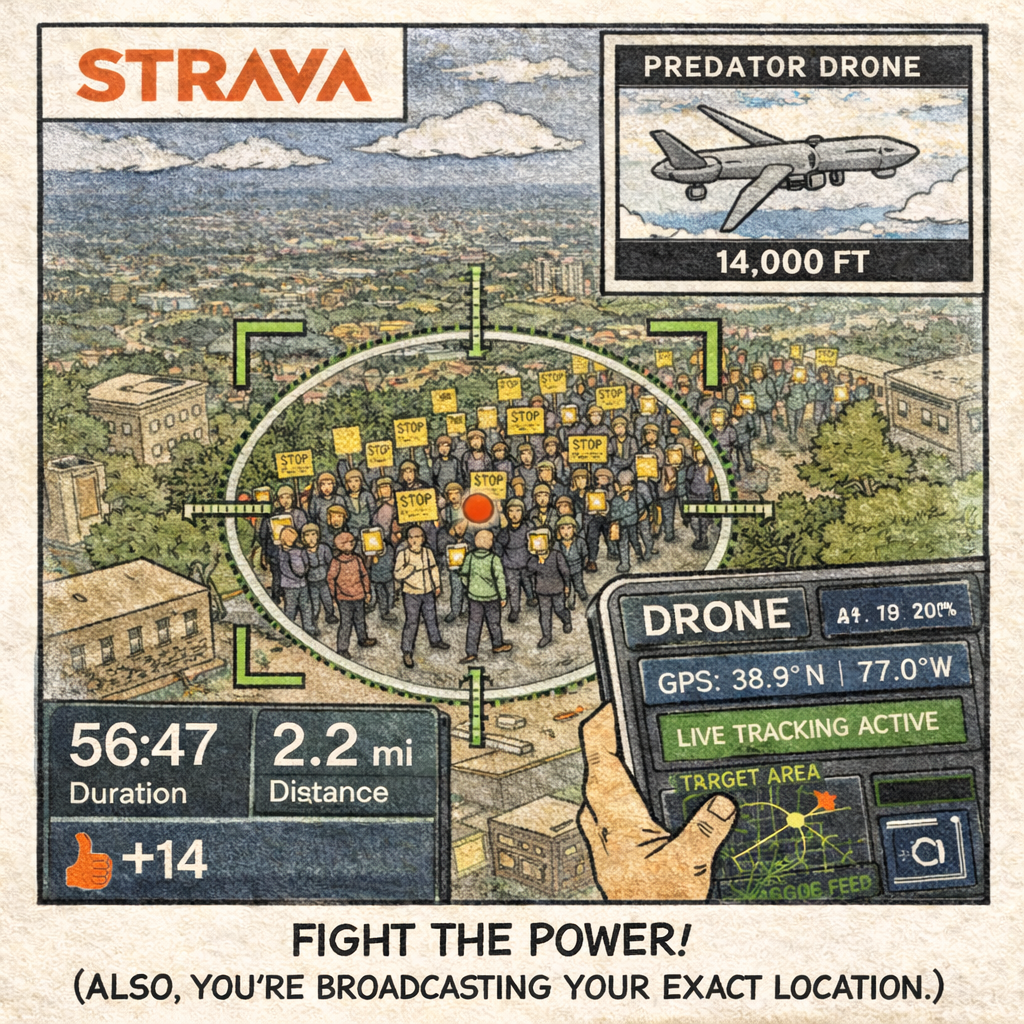
The Man Knows Where You Are
One of the strangest parts of modern protest culture is that everyone shows up carrying a tracking device on their wrist and another one in their pocket. Not because they’re being careless. Because that’s just what a phone and a watch are now.
We already know how this plays out, because the military learned it the hard way. Strava heat maps once revealed secret bases overseas, not through espionage but through jogging. Soldiers went on their morning runs, their watches logged GPS tracks, and suddenly “empty” deserts lit up like Christmas trees. Nobody was spying on anyone. The pattern itself was the leak.
Crowds work the same way. One Apple Watch is just a heartbeat. Ten thousand Apple Watches moving down the same street at the same time is a signal. Phones, carriers, Apple, Google, ad networks, and analytics systems all see density, motion, and clustering in near real time. They don’t need to know who you are to know something is happening.
There are systems that trigger on this. Not sci-fi, just logistics. Too many devices in one area, moving together, staying together, dispersing suddenly. That’s how traffic apps detect jams. It’s also how authorities, companies, and emergency systems detect large gatherings. A protest has a different fingerprint than a parade, a commute, or a concert. The machines can tell.
This is why military gear works the way it does. I own a Garmin Instinct 2 Tactical. It has a kill switch for radios and tracking because in the real world, emitting location data gets people killed. That doesn’t make me Jason Bourne. It just means the risk is real enough that engineers design around it.
Of course, it’s almost funny, because I still carry a phone. Most people do. But the principle matters. If you’re going to “fight the power,” you are doing it while broadcasting your coordinates to dozens of networks. This isn’t paranoia. It’s math.
Every protest today creates two crowds. One in the street, and one in the data. And the data crowd never stops being watched.