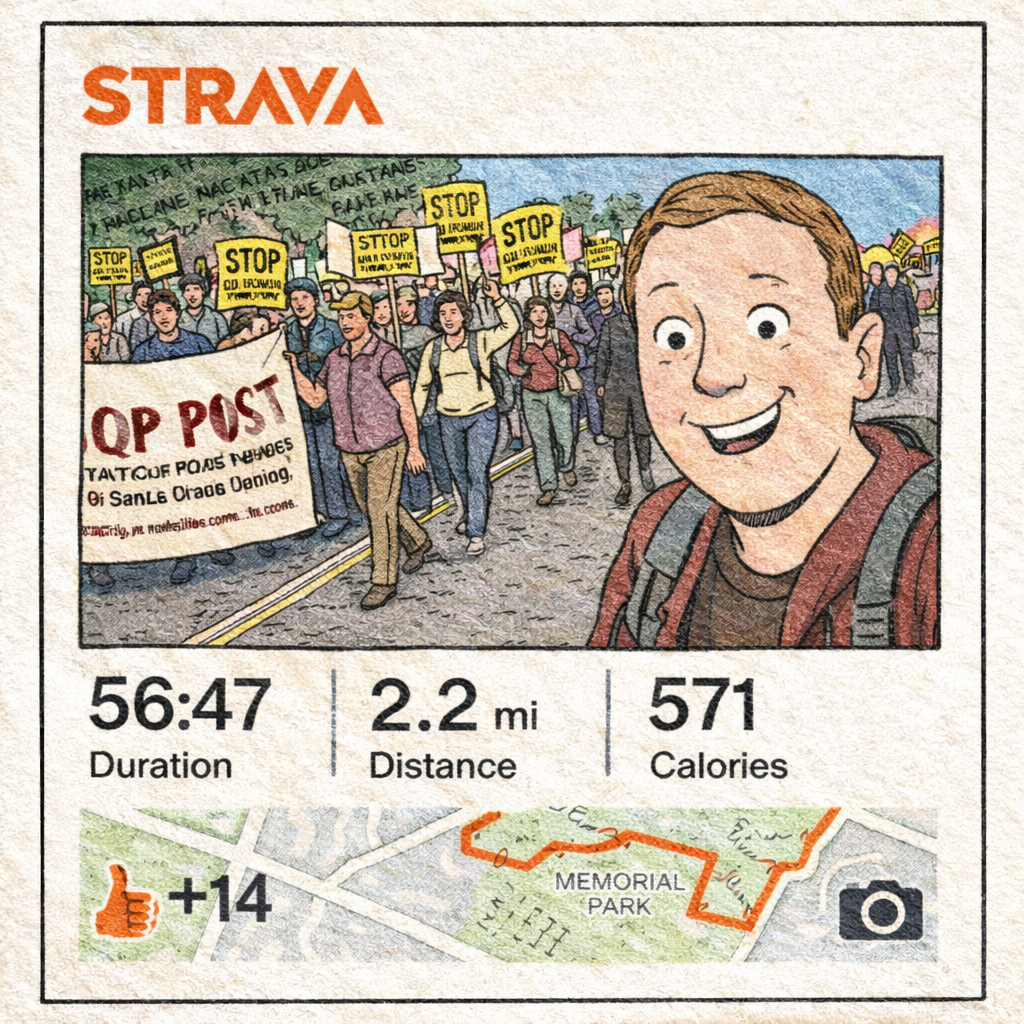
Strava or It Didn’t Happen
Somewhere in every modern protest there is a man whose face looks like it has been gently erased by ten thousand steps. He is not angry, exactly. He is… aerated. His pores are open. His calves are telling a long, detailed story. He has walked for justice and possibly also for a personal best.
We used to measure protest in slogans, in signs, in whether the cops looked nervous. Now we measure it in miles.
The other night I watched a river of activists flow down the avenue, cardboard signs bobbing like nervous lilies. Their chants rose and fell, their feet slapped the asphalt, and all I could think was, wow, somebody just closed a ring. Somewhere, a smartwatch vibrated with the quiet, religious thrill of achievement.
This is the age of Strava.
If you are not yet part of this amber-glowing hive of endurance worship, Strava is a social network for people who believe that movement must be recorded or it was merely theoretical. It is Facebook for quads. Instagram for hamstrings. A place where you can upload your run, your ride, your walk to get oat milk, and receive small digital pats on the head called kudos from people who also have sore hips.
Strava does not care why you moved. It only cares that you moved, and preferably in a clean, continuous line.
This makes it perfect for modern activism. A march is, after all, just a very political long walk. A protest is a parade that refuses to clap. And every parade, even an angry one, is a chance to rack up some delicious, righteous mileage.
I like to imagine the secret life of the crowd. The signs say Stop This, Justice Now, End That. But the watches say 2.3 miles, 412 calories, moderate heart rate, new personal record on Constitution Avenue. One activist is yelling into a megaphone while quietly hoping the route takes a little detour past the park, just to get a round number.
There is something almost beautiful about it. The marriage of moral urgency and Fitbit piety. The idea that you can fight the system and also beat your neighbor Dave from Silver Spring in weekly distance. We used to talk about “showing up.” Now we talk about “logging it.”
Because if it’s not on Strava, did you really resist? Or did you just sort of… stroll? I picture the future historian. Not poring over manifestos or news footage, but scrolling through heat maps. Here, in red, is the great march of 2026. Here, a smaller but very efficient rally, notable for its tight pacing and low elevation gain. Here, an outlier who walked fourteen miles for a cause and then, tragically, forgot to hit “record.”
The tragedy is real. To walk for justice and leave no data behind is to become a ghost. There is a certain democratic poetry in all this. Strava doesn’t care who you are. It doesn’t care what you believe. It just wants your steps. A billionaire and a broke college kid are equal in the eyes of the GPS. You are all just blinking dots on a map, sweating toward something.
In a world where everything is argued, counted, and disputed, it is oddly comforting that at least your feet are telling the truth.
So yes, I admire them. The marchers with their flattened sneakers and their digitally immortalized routes. The activists who fight power and chase their step goals at the same time. They are not just moving history. They are moving at 3.1 miles per hour, with a heart rate that suggests decent cardio health.
And somewhere tonight, as the chants fade and the streets empty, a hundred phones will glow in the dark. A hundred little victory screens will appear.
Activity saved.
Kudos earned.
Revolution logged.