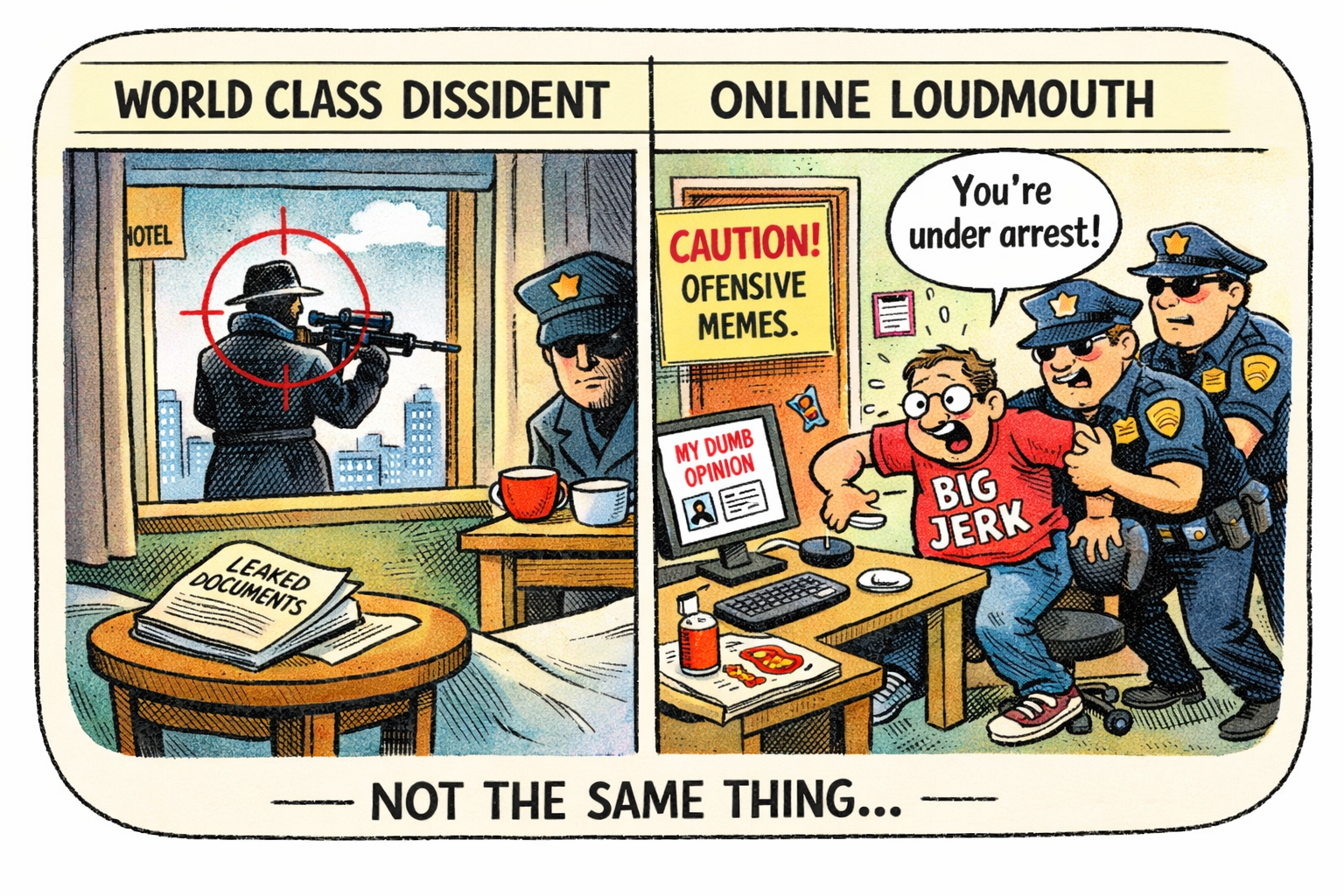
There is a meaningful distinction between rare, targeted state violence against elite political dissidents and the routine criminalization of ordinary speech.
High-level dissidents such as exiled officials, influential journalists, or opposition organizers operate within power struggles that states treat as existential threats.
Violence against them, while indefensible, is exceptional rather than systemic.
By contrast, arresting everyday citizens for online speech represents a different and arguably more corrosive form of repression.
When speech laws are enforced broadly and bureaucratically, they reshape social behavior at scale. Ordinary people begin to self-censor not because they challenge power, but because enforcement is ambient, unpredictable, and normalized.
The existence of extreme cases of repression elsewhere does not justify expanding speech policing in liberal societies. Nor does elite political violence serve as a useful benchmark for evaluating domestic speech restrictions.
The danger lies less in rare acts of spectacular repression than in systems that quietly criminalize expression for everyone.