
The most dangerous seven or eight words Americans say are: “I’m on the right side of this,” “we’re on the right side of this,” or “you’re on the wrong side of this.”
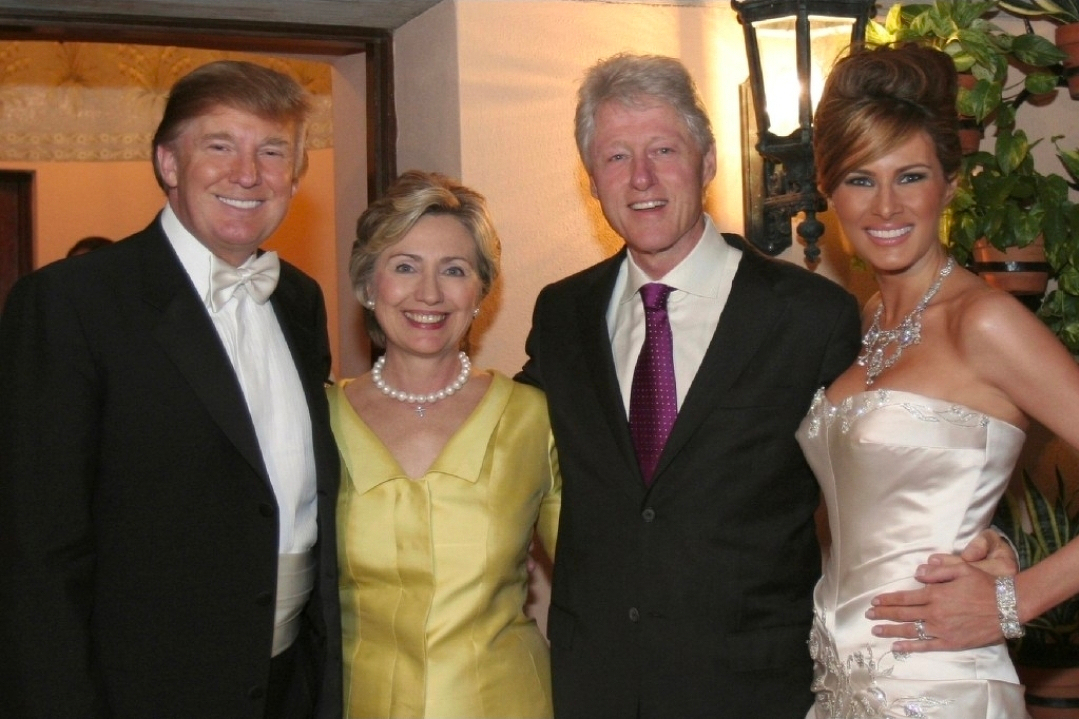
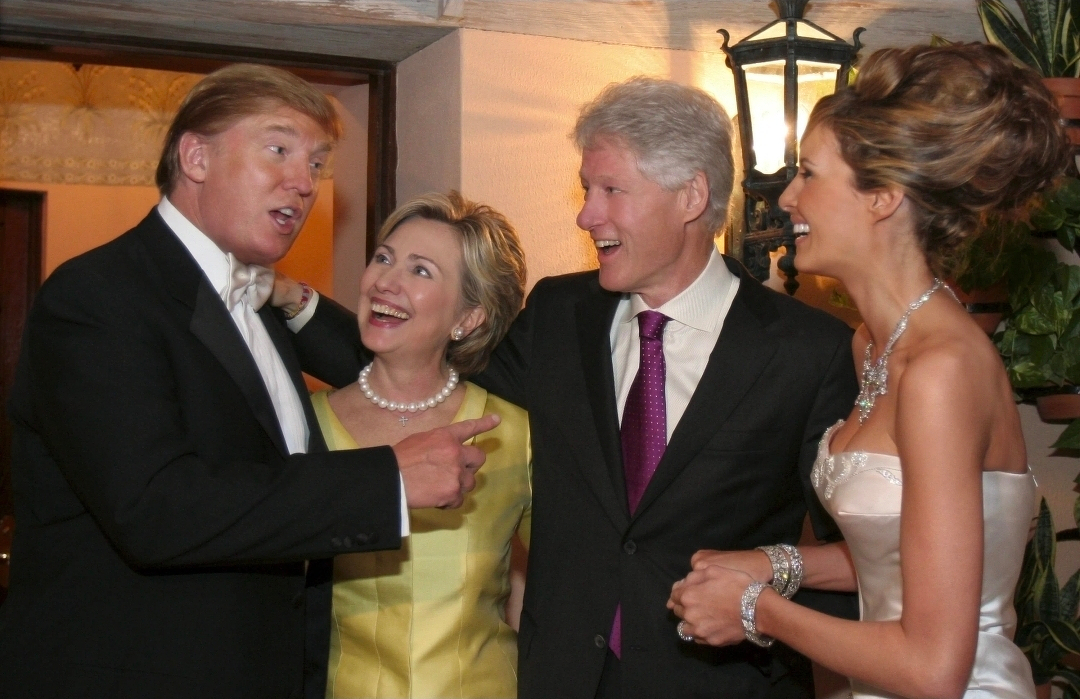
Unintentionally promoting Orbán’s mission and ministry to people who might support his vision?
Viktor Orbán: Last Week Tonight with John Oliver (HBO) youtube.com/watch
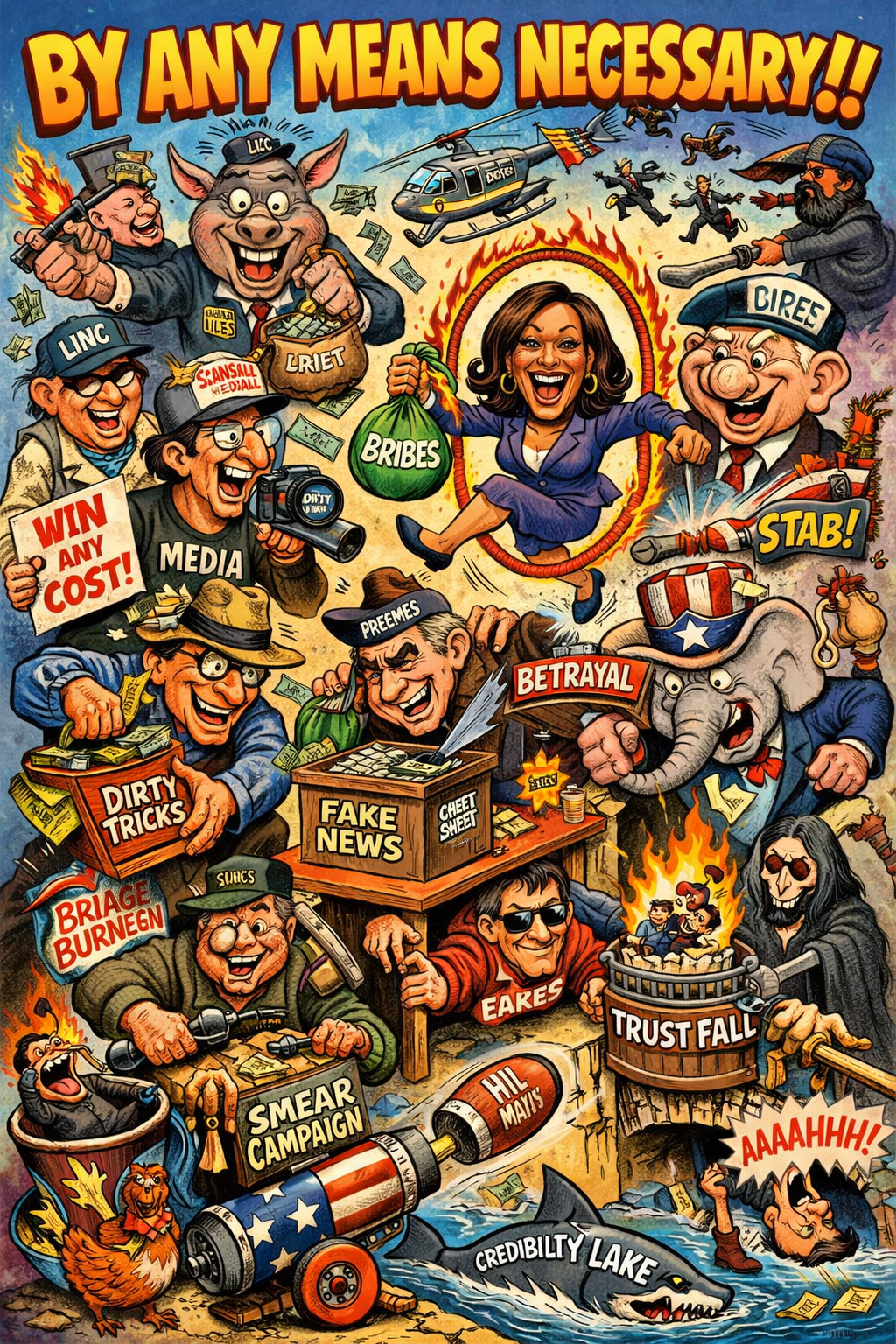
“By any means necessary” is what people say when they’ve decided the goal matters more than trust, norms, honesty, or credibility. But that kind of all-in strategy can fail, backfire, and leave you with unintended consequences so severe that you cripple your ability to persuade or lead for years.
When a protest tries to cover everything—war, immigration, Trump—it ends up saying nothing specific. Compare that to Roe v. Wade: one issue, one demand, one goal. If everything matters, nothing is actionable. www.nytimes.com/2026/03/2…
Trump Demands Patriotic Coverage of the War in Iran. Or Else…. | On the Media | WNYC Studios www.wnycstudios.org/podcasts/…
Trans People are Facing a ‘Dual State’ in Trump’s America | On the Media | WNYC Studios www.wnycstudios.org/podcasts/…
The Pentagon Kicks the Press Out … Again | On the Media | WNYC Studios www.wnycstudios.org/podcasts/…
I’m amazed that child abuse has suddenly become a major issue for the left to wield against the right.
I’m amazed that child abuse has suddenly become a major issue for the left to wield against the right. Just yesterday, anti-trafficking, anti-child abuse, anti-grooming, and anti-sexualization were causes the right loudly claimed as its own, aimed almost entirely at the left. From Pizzagate to QAnon to “Save the Children,” the right spent years centering this rhetoric through the Trump years and into Biden. “Groomer” became a political weapon tied to schools, drag, and curriculum fights. Now the narrative has flipped, and the right is being branded as the threat. It feels less like discovery than mirror-fighting: same accusations, new target. That said, I’m on team protect the children, period. If the left accuses the right, and the right accuses the left, fine. Good. Keep the pressure on. Just make sure it leads to actual protection and real consequences, not just slogans, hysteria, and partisan theater.
When a Rightist issue becomes the Leftist issue.
I’m amazed that the whole child abuse thing has become an issue by the left against the right. It was just yesterday that anti-trafficking anti-child abuse was an issue only heralded by the right against the left. From Pizzagate to QAnon to “Save the Children,” the right spent years centering anti-grooming, anti-trafficking, and anti-sexualization rhetoric, especially through the Trump years and into Biden. “Groomer” became a political weapon tied to schools, drag, and curriculum fights. Now the narrative flips, with the right branded as the threat. It feels less like discovery and more like mirror-fighting: same accusations, new target. Turn-around.
Someone said I look as old as dirt and my response was sure I look as old as dirt but you are as old as dirt. I’m such a classy guy.
Honor culture is a social system where reputation, respect, and perceived strength are central. Individuals are expected to defend status and respond to slights to maintain standing. It often emerges where formal institutions are weak or trust is uncertain.

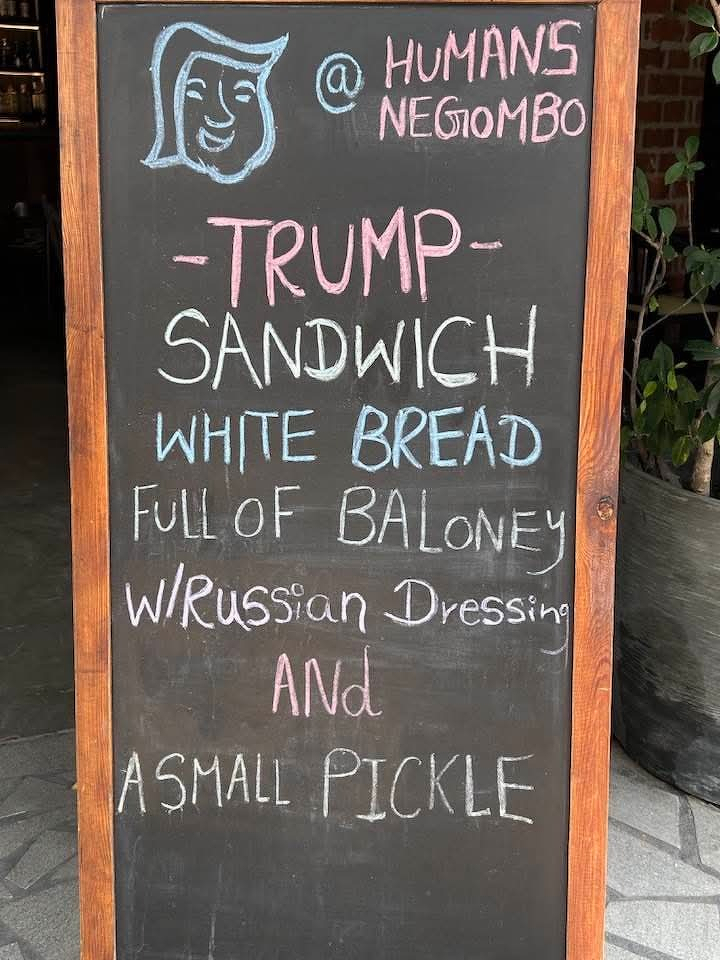
That objectively is a delicious sandwich. But I’m a Gen X kid who grew up in the ’70s and that’s all my parents ever fed me.
“Catching print” used to be only a concealed carry (CCW) conversation. [Content Warning] youtube.com/watch
Amazing media and propaganda analysis. Brilliant. youtube.com/watch
Manufactured outrage is the dark art of turning low-frequency events into high-intensity consensus.
Manufactured outrage is the dark art of turning low-frequency events into high-intensity consensus. You take something real but statistically rare, remove context, widen definitions, and repeat it until it feels ambient—like it could happen anywhere, anytime. Fear does the rest. Once people feel under siege, they’ll accept almost any “solution,” even if it quietly rewrites the rules.
The pattern is consistent. Step one: find a visceral anchor—something involving children, safety, identity, or betrayal. Step two: blur categories so edge cases count as the norm. Step three: saturate attention until perception detaches from probability. Step four: present a preloaded fix that just happens to expand authority or restrict behavior. The outrage isn’t accidental; it’s the delivery system.
This isn’t partisan. The right has done it. The left has done it. Moral panics about crime, drugs, culture, elections—you name it. Each wave reframes the same mechanism: define a threat broadly enough, repeat it loudly enough, and people will trade precision for protection. Once fear is the lens, nuance looks like denial and skepticism looks like disloyalty.
Statistics get bent in the process. Categories get bundled. Context gets buried. A complex mix of causes becomes a single, emotionally satisfying villain. And once that villain is installed, policy debates stop being about trade-offs and start being about urgency. “Do something” replaces “do the right thing.”
The result is a kind of civic autopilot. People think they’re responding to reality, but they’re often responding to a curated version of it—one optimized for reaction. It’s not that the underlying problems are fake; it’s that their scale, framing, and meaning are engineered.
If you want to resist it, you don’t need to pick a team—you need better optics. Ask what’s being counted, what’s being bundled, what’s missing, and who benefits from the emotional spike. Outrage can be justified, but when it arrives prepackaged, synchronized, and oddly convenient, it’s worth checking whether you’re seeing the fire—or the spotlight.
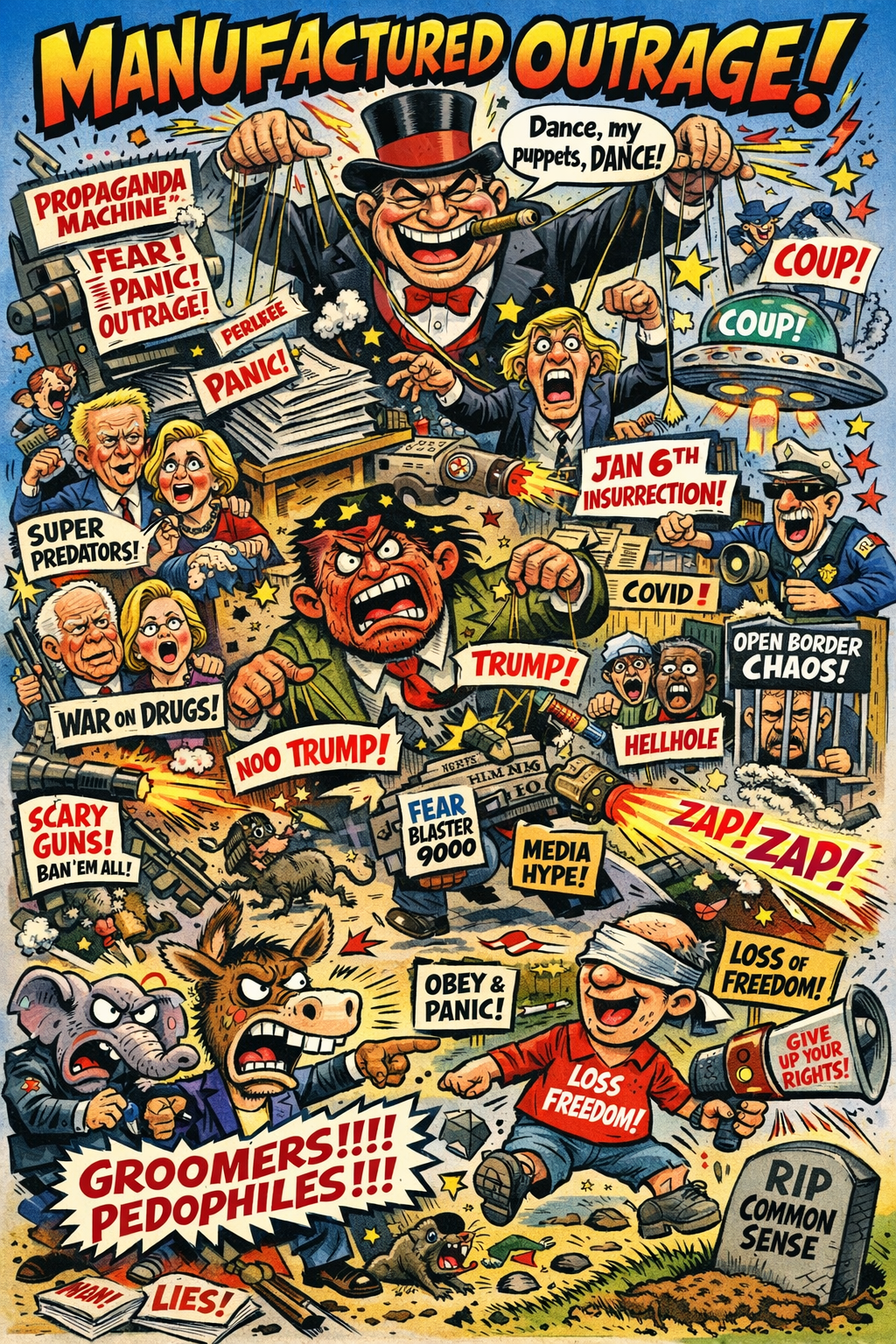
Manufactured outrage is political fuel. Amplify rare horrors, strip context, spike fear, then trade panic for power—new laws, fewer rights, tighter control. Left or right, same playbook: curate the threat, inflame the crowd, then “solve” it by moving the goalposts.
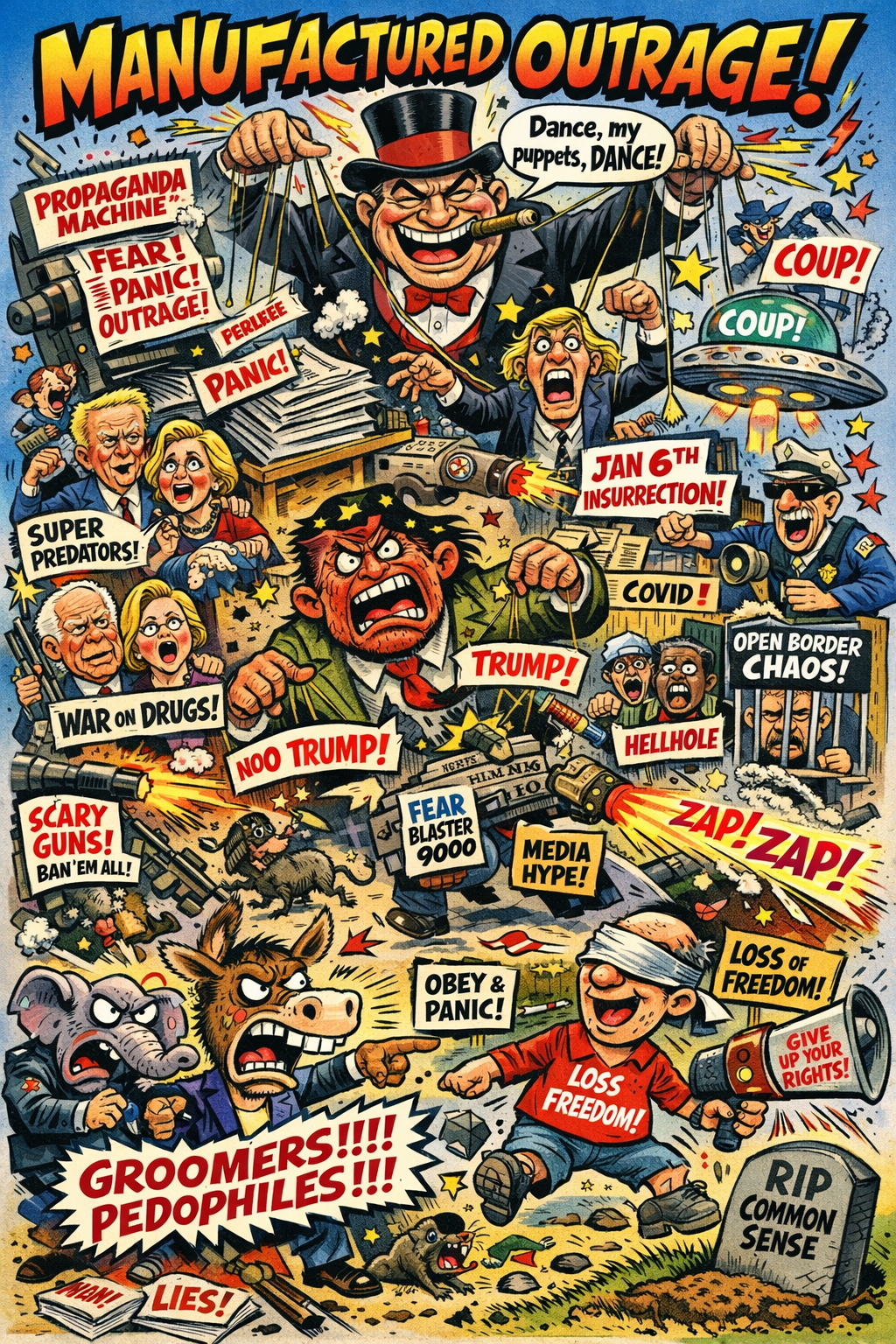
What started as shitposting has turned into a kind of accidental field study.
What started as shitposting has turned into a kind of accidental field study.
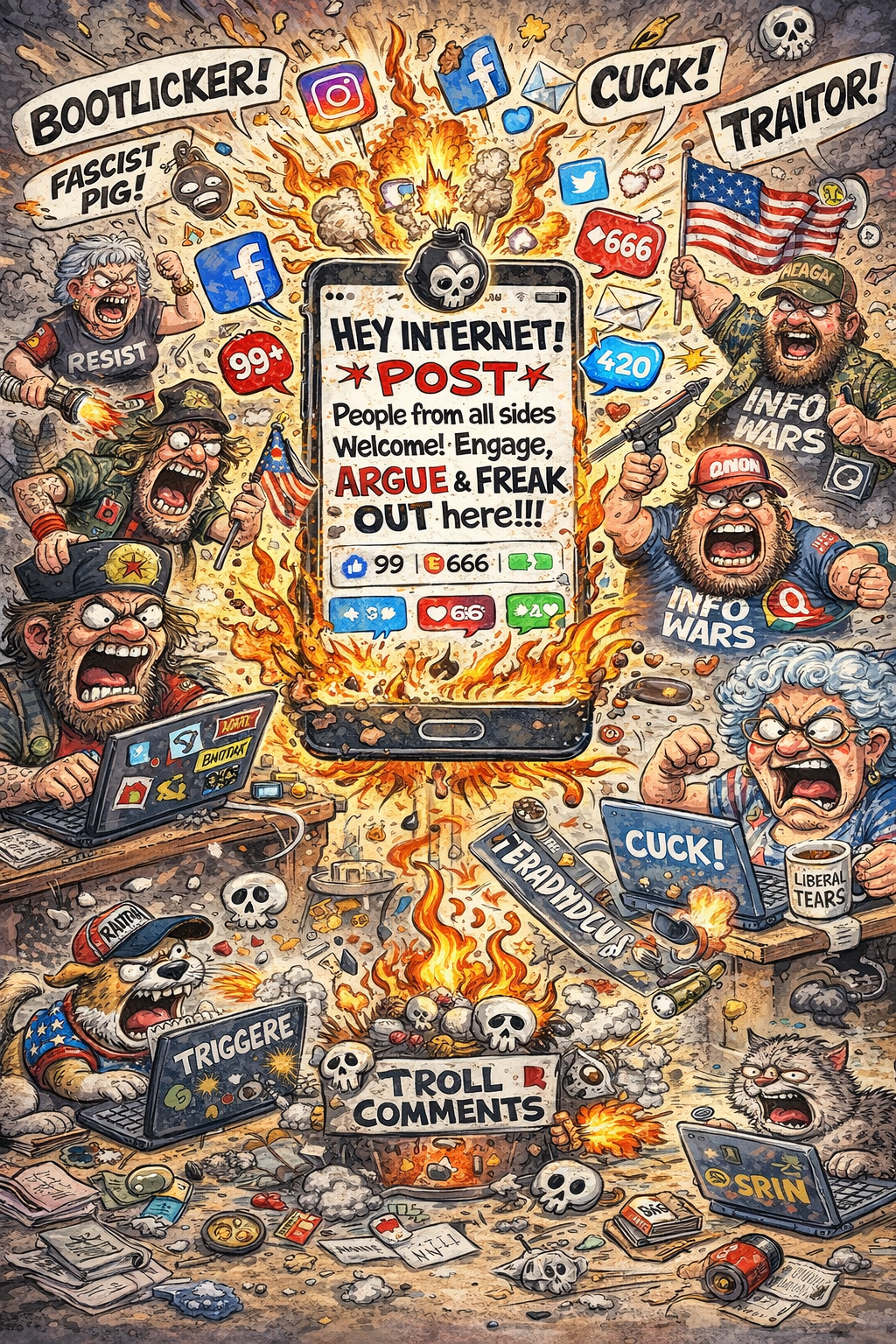
By posting across Facebook, Threads, Instagram, and beyond, I’m no longer just talking to the same familiar circle. I’m pulling in responses from people I would never encounter in my day-to-day life in Arlington. And what’s striking is not just disagreement—it’s intensity. I’m hearing arguments, language, and levels of certainty from both the left and the right that I genuinely didn’t know were this widespread or this raw.
Early on, I would delete posts when the reactions got too heated or uncomfortable. There was still a reflex to manage perception, to smooth things over, to retreat. That’s mostly gone now. I leave the posts up. I let people come in hot. I let the reactions stand. Over time, that has made me less fragile, less defensive, and more curious. I’m not doing it because I think I’m above any of it. I’m doing it because repetition changes your tolerance. You stop flinching. You stop cleaning up the evidence.
Facebook lightly monetizing the whole thing also changed my psychology more than I expected. Not because the money matters that much, but because it gives the whole enterprise a weird little mercenary honesty. Fine. I sold out. Fine. The capitalist system is giving me a tiny reward for stirring the pot. That somehow feels less embarrassing than pretending every post is a noble act of conscience. It makes me bolder, not more righteous.
And the strange thing is that people on both sides read me as belonging wholly to the other side. Some Democrats think I have knee pads for Trump. Some people on the right think I’m basically a communist with my head up Mao’s ass. That split is part of the point. I’m not trying to join a camp. I’m testing what happens when you say something vivid, sensory, unpopular, or unstable enough to make people reveal themselves.
That’s the real value of it. I’m hearing voices I never used to hear. I used to think only the right had the real potty mouths, the real edge, the real appetite for calling everyone traitors and degenerates. Now I’ve seen how fast parts of the left collapse into the same kind of single-track moral bullying, except with words like “bootlicker” doing all the heavy lifting. Different dialect, same missionary certainty.
So this isn’t an apology and it isn’t a defense. It’s closer to a thesis: shitposting, especially when cross-platform and lightly monetized, can function as an unintentional social experiment. It exposes submerged voices, tests tribal reflexes, and toughens the poster. I used to delete. Now I observe. That’s the method.
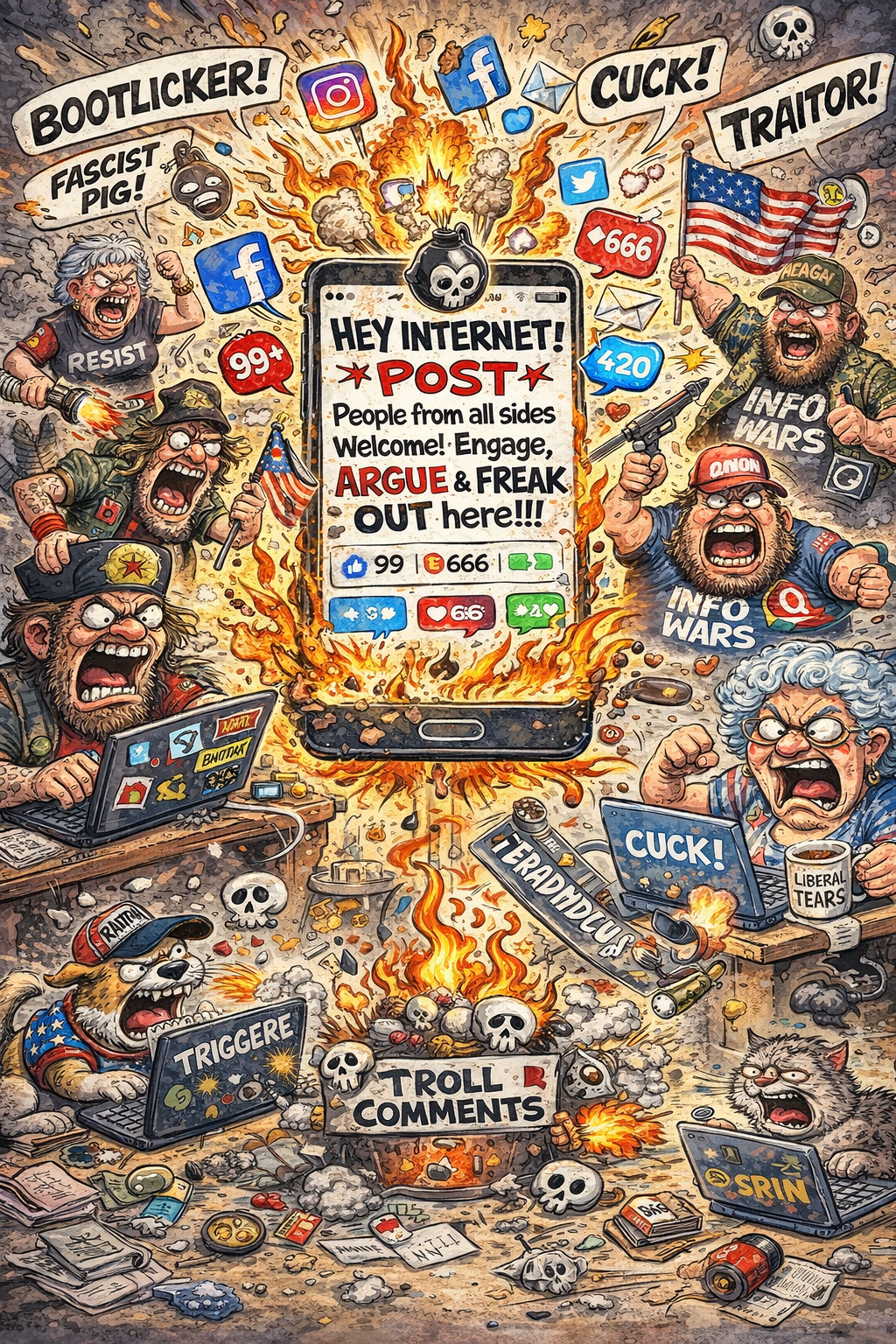
I started shitposting and accidentally built a social experiment. Pulling in voices from Facebook, Threads, IG—people way outside my Arlington bubble. I used to delete posts; now I let them ride. Monetization weirdly made me braver.
There’s A LOT of VETERAN-WASHING.
Army veteran faces conspiracy charges after participating in anti-ICE protest youtube.com/watch